
July 27, 2026 - Full Show
7/27/2026 | 26m 49sVideo has Closed Captions
Watch the full July 27, 2026, episode of "Chicago Tonight."
Illinois tolls could be going up. We tell you what you need to know. And no more changing clocks? How a new daylight-saving proposal could impact your daily life.
Problems playing video? | Closed Captioning Feedback
Problems playing video? | Closed Captioning Feedback
Chicago Tonight is a local public television program presented by WTTW
WTTW video streaming support provided by members and sponsors.
July 27, 2026 - Full Show
7/27/2026 | 26m 49sVideo has Closed Captions
Illinois tolls could be going up. We tell you what you need to know. And no more changing clocks? How a new daylight-saving proposal could impact your daily life.
Problems playing video? | Closed Captioning Feedback
Where to Watch Chicago Tonight
Chicago Tonight is available to stream on pbs.org and the PBS app.

WTTW News Explains
In this Emmy Award-winning series, WTTW News tackles your questions — big and small — about life in the Chicago area. Our video animations guide you through local government, city history, public utilities and everything in between.Providing Support for PBS.org
Learn Moreabout PBS online sponsorship>> Hello and thanks for joining us on Chicago tonight.
I'm Brandis Friedman.
Here's what we're looking at.
Your future commute could cost you more as Illinois considers the toll hike.
What to know about the plan.
And a permanent switch to daylight saving time could be coming.
A look at the potential impact on businesses and your health.
>> First off tonight, tornado warnings, severe thunderstorms and heat advisory.
We're all in the year for the Chicago area today.
And a severe thunderstorm warning with golf ball-sized hail is just now ending for Chicago.
Cicero and Arlington Heights.
Other parts of the area are still under storm warnings for the next half hour or so.
Comed says more than 400,000 customers have been impacted by the 80 mile an hour.
Wind gusts, hail and lightning that's brought down trees and power lines.
Their outage website is currently unavailable but they say they are working quickly to restore it.
The National Weather Service says there could be more severe weather with a 40% chance of showers and thunderstorms remaining mainly before 9 tonight.
The American Red Cross is sounding the alarm over the country's blood supply.
Declaring it a national crisis for only the second time ever.
The organization says blood donations are not keeping pace with hospital demand, which is up during what they call the summer trauma season.
Blood donations are at a four-year summer low with extreme heat.
Poor air quality and widespread food borne illnesses, all contributing to low or donor turnout.
Red Cross says it has less than a one-day national supply of blood type O positive.
That's the most commonly transfused and he's only typed individual hospitals.
They're encouraging people to make an appointment to donate, seeing all saying that all blood types are needed on information on how to book that appointment.
You can visit our website.
If you think your neighborhood park needs better lighting or pollinator gardens or more picnic tables, voting is open to let the Chicago Park district know what you think starting today through next month, Chicago residents can submit a ballot either at Park District Field houses or online, identifying local park needs and proposing ideas for improvements.
The citywide participatory budgeting program means the district will spend $500,000 on the top vote getter among the following 4 categories, accessibility, public safety and inclusion, recreation infrastructure, permanent fixtures and park amenities amenities and nature and beautification each of these categories has about 9 projects across the city where the money will be used for details on how to vote.
You can head to our Web site.
While your commute could be getting more expensive right after this.
>> Chicago tonight is made possible in part by the Alexander and John Nichols family.
The Pope Brothers Foundation.
And the support of these donors.
>> Driving on the Illinois Tollway could cost you more in the near future.
The Tollway board is considering a 15 year.
26.5 billion dollar infrastructure plan that would widen highways and ease congestion across northern Illinois.
But the proposal would also raise passenger vehicle tolls beginning January.
1st by roughly 57% or about $0.45 per toll.
Supporters say the plan would boost the region's economy and modernize aging infrastructure.
But critics argue the board is moving too quickly and giving the public a little time to weigh in.
Here to help us understand our Bryce Hill, director of fiscal and economic analysis with the Illinois Policy Institute and Cara, principally counsel for the Indiana, Illinois Iowa Foundation for Fear Contracting construction industry nonprofit that promotes public projects.
We also invited representatives from Illinois Tollway, but they did not respond.
Bryson car, thanks to the both of you for joining Thank you.
Rice, the Illinois Tollway, calling this investment, be driving connections.
Plan.
It raises the toll fee $0.04 per mile or roughly $0.45 per toll.
And we'll address congestion and deterioration on many of northeastern Illinois aging interstates.
What are your concerns with this plan?
My concern is that we're seeing really the culmination of a broken political process here.
So this entire concept kicked off late last year when Governor Pritzker signed the Transformational Regional Transit Authority funding plan.
And at the time Speaker Welch said toll hike was the cost for union support of that plan.
So now the Tollway board, which is appointed by Governor Pritzker is going to decide what that whole hike is and where that money will be dispersed and ultimately former Tollway board member and state Senator Bill Moore said that it seems as though lawmakers decided to hike tolls first and then are now rushing to >> put together this plan to justify that increase current your organization, you help construction companies lands big projects like this one.
What would a 26 billion dollar investment mean for?
>> Engineers and construction workers in northeastern Illinois.
Yes, oh, well, we can look back to the last capital plan, move on oil that we have statistics that we have statistics for already 15 years of data.
That plan raise 1.2 billion dollars in state and local tax revenue.
14 billion dollars was invested into that plan and we received 20 billion dollars of economic output.
150,000 jobs over the course of that 15 years, 6, almost 6,000 jobs per year where construction jobs and in addition, there investments made into apprenticeship program 150 million dollars over the course of that program.
So those are big investments that help our members and our cars.
Our contractors, Rice is is your biggest concern, the political process by which this came into being or is your concern about?
>> total amount of this size is unnecessary, that there's another way to fund the the repairs that the agency says are needed.
I think it's a bit of both.
So obviously there's a political nature of the entire process and how it played out.
But also a question of whether or not this is what's needed right now.
We're actually in year 2 of of a new capital plan from the toy that started in 2025.
Called Bridging the Future.
So that shows that tow hikes are unnecessary at this time.
It's a seven-year plan around 2031 uses only current revenues and then not only maintains current infrastructure that whole way, but it and it invest money into improvements.
Abso currently tollway revenue collections or 1.3 billion dollars above maintenance and operations, meaning that there's hundreds of millions of dollars available for new investments in infrastructure.
And the current capital plan that we're only in year 2 of 7 of shows that there's a model for not only maintaining our roads but improving them without requiring a mask of toll hike.
So as we mentioned, Bryce, that the plan would raise the cost per told for passengers by about $0.45 per toll.
>> May not seem like a lot, but your organization estimate that that could add up to an additional 17 billion dollars through the year 2042. talk about the costs that that drivers motorists could be facing.
for a typical commuter paying the average transaction cost if they're commuting to and from work 50 weeks a year, 5 times a day.
That's going to represent $225 in additional travel costs and expenses.
it's also going to be 30% commercial vehicle.
toll increases.
Well, that's going to affect the price of consumer goods.
So just based on current traffic patterns alone, that would generate 17 billion dollars in additional revenue for the tollway but that's the cost being paid by consumers and drivers ultimately.
And another important peace to note is that the toll hike is actually going to include an automatic increase every 2 years.
So the toys considering this measure once, but then every 2 years there's going to be an automatic increase associated with it, leaving little accountability for a future toll board.
4 today's action, a car, you know, because Bryce mentioned the cost per told for commercial drivers by $0.30 as well.
That hamper businesses that transport goods on Illinois highways.
I understand the cost to consumers and businesses, but commercial vehicles make up 13% of vehicle miles traveled on the busiest corridors.
You I to 94 so I understand that there's a cost to investing, but there's a real cost to not investing because those roads will start deteriorating.
That cost businesses time that costs businesses money.
So feeling to invest this big cost as well.
Yeah, let's talk about that a little bit more because officials, Illinois tollway officials say the plan would actually save drivers about $725 a year by reducing vehicle repairs, fuel costs that are caused by poor road conditions.
How do deteriorating roads add up costs for drivers motorist?
I time spent on the roads, productive loss productivity, Lawson And then those costs passed on to the consumers.
Right?
So if you're driving on a bumpy.
Road, that's not in good shape and you get a flat tire gets knocked out whatever the case may be.
All right, rice, the tollway also says that the average Chicago drivers spend about 100 hours per year in traffic resulting in about $1800 in last time.
What do you make of that argument that, you know, investing in the road since of saving passengers or drivers time and money in the long run, think having high quality infrastructure is is obviously benefit to everybody.
That's why the toy already spend so much money.
>> On its infrastructure already, we also need to consider that these projects are these construction projects are causing some of that congestion.
So some of that lost time is is because of this construction.
We've seen many of these areas are already being under repair Andreessen capital plans are even actively right now.
So some of that would be contributing to additional congestion.
But beyond that, I think that again, this is we've had less than 2 months of consideration for the entire plan.
Details when available until mid June public comments public hearings were held one time in every county where the toy operates for 1, 2 hour period that I'm sorry past.
On August 3rd, public comments made online or via mail are going to close entirely.
And the board cuts bow to soon as August.
19th 2 approved this toy.
Ken, a 26.5 billion dollar plan.
That's 2 months to decide.
A permanent toll increase in billions of dollars in spending.
That's too little time.
>> Cara, we do have a name for it.
In northern Illinois.
It's construction season right on that whole ways.
Last major capital program move, Illinois launched in 2020 12.
It's only scheduled to wrap up next year.
What economic impact has that project had on how many jobs to create?
Yeah.
So it created 150,000 jobs over the course of the 15 years, 10, almost 11,000 jobs per year, 6,000 of which were construction.
As I stated.
>> There was 100 nearly 150 Million.
That it.
That was put into apprenticeship contributions.
And so that creates the next generation of workers to help build these road safely.
And I will add that hourly wages for construction work went up from 30 to $48 an hour.
That's a 61% increase.
So that's all good for our members and will end.
But will another 15 years of construction make congestion and traffic worse in certainly driving on roads that are under construction or also.
>> Damaging to your car.
I think that's a short-sighted argument because eventually that will cause roads to better.
Use improve, modernize the roads, reconstruct roads, make better interchanges and such.
No make sure Bison wanted add something to Illinois Department of Transportation rates.
100% of of the miles on the tollway.
>> At the Miles at acceptable and safe, which is far higher than the statewide average.
And I think the current capital plan and the current excess revenues that the toy already generates are just proof that roads can effectively maintained and actually improved upon at current levels.
I think that that's proof that the previous capital plan worked.
And I don't think that revenues, the capital need for the next 15 years.
>> So Bryce, you've you've urged Illinois and staff the tollway board to reject this plan.
It sounds like you don't trust that they're going deliver the economic benefits that that they're promising.
Sure at, you know, older listeners and viewers will remember that when the toys originally established in 1953, the slogan was toll-free by 73.
>> 50 years later, the toys collecting record amounts of revenues were considering the largest increase ever.
So yes, I don't have most the most confidence in.
Today saying what the future will hold if we give this power to the tollway authority and then beyond that, I don't think that Illinois and should give up.
And this one instance, the ability for the toll way too increased tax holes in perpetuity every other year.
With that automatic inflation adjustment.
We've seen what's happened in the state's road fund with the Motor Fuels tax being indexed to inflation.
It was doubled in 2019 and then index to inflation annually every year since.
In those 6 years, we've seen 2 times where the legislature has paused that increased because inflation got so high that was damaging to consumers.
There's a real threat to the happens here with this with this automatic increases tied to inflation as well.
All right.
We know that online public comment closes August 3rd, those community meetings ended last week.
>> And we know that you've had some criticism for the amount of time that they've accepted public feedback car, you know, the way board meets on August.
19 couple seconds left.
What's next?
What you expect to happen Well, hopefully this passes.
I think that the public comment that we've involved in has been good positive.
People want this from what I've a number for robust >> So hopefully they get past.
All right.
We'll see what happens.
Bryce Hill Car Principia, thanks to both for joining Thank you.
>> Up next, reaction to the possibility of daylight saving time becoming the norm.
You're around.
Every year.
Many Americans dread losing that hour of sleep when changing the clocks.
But actually pricier.
But that might not be a problem for them much longer.
2 weeks ago, U.S.
House lawmakers passed the Sunshine Protection Act, a bill that would make daylight saving time permanent advocates say the switch would allow more time for outdoor activities and boost businesses.
But critics say the health and public safety impacts far outweigh potential benefits.
Joining us to talk more about the bill are shooting Leong administrator at the Rogers Park Chamber of Commerce and Eric Albrecht senior advocacy program manager at the American Academy of Sleep Medicine.
Thanks to both for joining us.
So Eric, would you please start by just explain the differences between daylight saving time in daylight?
Standard Time?
>> Absolutely.
So permanent standard.
Time is the healthy, safest choice for all Americans, permanent daylight Savings Time would take away morning light from us.
That would lead to increased car accidents.
That health complications and so permanent standard time is a healthy choice.
The American Academy of Sleep Medicine came out a statement in 2020 that advocates for that.
We reaffirmed that we formed a coalition, the current coalition for Permanent Standard Time.
And we've been talking about this.
But lawmakers for the past several years, right?
Okay.
So that's that's permanent.
Saving or permanent standard time.
>> yeah, we can kind of talk about what that means as well.
But right now, everybody kind of remembers the spring forward in the spring.
When you set your clocks forward in the fall back when you set or when you want your clock back to win a state like standard time, then what would permanent daylight saving time mean for Midwestern states?
Superman to light savings time lead to a long, dark mornings.
>> It actually would have sun rises past ATM for almost 70 days in the Chicago Land area.
And so that winter, the coldest days in the winter, it yes, the coldest days.
And so that would approach almost 9 o'clock part of the year and for other parts of the country, they'll have sun rises past 09:00AM and that will extend the timeframe that they have past 08:00AM for up to like 150 >> Trudy advocates for permanent daylight saving time.
They see that one benefit is more sunlight and outdoor time for kids in the evening.
How would businesses also benefit from that?
>> on surface, a businesses would benefit from day, I say, permanent daylight Savings Time, being able to open later and then have customers come in morale is into the day.
However, if there is a downside to because sir, up, are As you know, all businesses did it bright alert employees.
Let's say those out late having fun many, many hours late into the night the previous day.
And then the morning without that, but sunshine wake them up.
Let's see what time does sun up a pick like about 9 or so that would be the condition that would be the case under permanent daylight Savings.
is like Yeah.
Might not told exactly.
And then Tulsa and place would be so tired.
First of hype from previous night.
>> And who knows when got to sleep at night.
And then in the they really don't wake up.
There's still groggy.
So the employers not have bright and alert to look for them.
And the most important part of a businesses that the place alert and ready to yes, specially get.
You know, talk about some industries like hospitality restaurants, where folks, you know, they're on the job, opening the doors pretty early.
But yes, even we got to get our Dunkin Donuts and coffee in Eric permanent daylight saving time.
It could have some pretty.
>> Serious effects on sleep.
Tell us a little bit about that.
>> Yes, so your body, everybody's aware of the adverse side effects that are cute.
When the time change happens there creased heart attacks, strokes, car accidents, medical incidences.
And so those people are aware of that as far as the time change goes but under permit daylight sick or daylight Savings Time right now your body is fighting against Daylight Savings Time the whole time.
It's the sun.
The sun controls.
Your internal circadian rhythm and standard time as more closely aligned with your human circadian rhythm.
So daylight savings Time sending you off an hour for the entire time.
You're on it.
made permanent.
Those effects never go away, right?
And we also know disruptions in circadian rhythm can also impact health.
Yes, what are some of those impacts?
>> Yes, so you know, increased, you know, increase heart and strokes.
You know, decreased mental health.
The important thing is that your body needs darkness at night to fall asleep.
And some light in the morning to wake up.
It sounds like a simple concept, but you know, the that melatonin that's produced at night, it's very important.
And the sunlight in the morning is the biggest indicator that suppresses that melatonin and allows you to wake up.
truly do anticipate, you know, business is starting to change their hours to accommodate this say opening later.
And just definitely they might.
But however, >> there is that the outside of fall >> happened before in Florida.
Once they changed it, then do a more accidents.
Cause we get hit by car in the coast, in the in in the morning then energy savings.
I think they want this event would much so even though that businesses might the might benefit on the whole.
I don't think that the what the benefit the entire of because I'm a community that much if everybody has a that there's a Canadian bit of mist that fence and improperly, right, right.
>> Erica, and their the health risks that are associated for kids and teenagers because especially for teens and kids for that matter, right.
Zeid more sleep in teens because their circadian rhythm is different.
How how might this impact them?
>> Yeah, absolutely.
as she just reference in 1974, outrage over permanent daylight Savings Time was caused because of so many accidents involving young kids.
So that's the direct safety impact.
But their health is impacted.
2 young children.
They're not aware of the time change or what time it is.
The Senate controls when they go to sleep hopefully and with the wake up and for teenagers, especially they're biologically predisposed to stay up later.
And so the Daylight Savings Time if they have dark warnings as well, it will be even harder for them to wake up.
>> Right and off to school, they go with all the responsibilities that kids have.
truly the city reports about 30 cases a business related burglaries a week, most of which do not result in an arrest being made.
Could an extra hour of evening daylight possibly bring some of those numbers down?
>> I don't think so a crime happens in the broad daylight to experience that it help.
>> Eric, the American Academy of Sleep Medicine.
As you've mentioned, you will support a change to permanent daylight standard time.
And you have introduced a bill that opposes the Sunshine Protection Act.
Tell us more about your bill and why the change the standard time do you think would be more beneficial from a health and sleep perspective?
Absolutely.
So the Sunshine for our Kids Act.
turned 96.
38 was introduced by Representative Mary Scanlon represent Pat Harrigan of North Carolina.
>> It's a bipartisan bill.
We have about 10 co-sponsors right now and it hasn't even been a month in this presents the only viable way.
10 o'clock changed that protects safety and health of all Americans, I guess, you know, there.
>> 3 scenarios, right change today, permanent daylight saving permanent daylight standard or just leaving things the way they are to the health benefits from no longer changing the clocks city out risk outweigh the risks of moving to permanent daylight saving We have host multiple studies about the adverse health effects, the economic potential economic benefits haven't really been proven it.
And they're mostly anecdotal.
>> The Congressional Research Services put out a report yesterday that noted that fact but also noted the fact that the health implications are well documented and so permanent standard time to get only choice.
If we want to get rid of the time, change.
And that's our position here treaty.
You know, couple seconds left.
How do you think a permanent switch to standard time would impact businesses?
>> I think that the in place probably what we have to consider Moses to employees they would be a this would so so used to getting up into At the same point of they going to sleep in a certain point if they think they will be a.
>> Us more alert account.
That's where we'll have to leave it truly Eric Albrecht, thank you both for the both for joining us.
Appreciate it.
Thank you.
And that's our show for this Monday night.
You can get Chicago tonight streamed on Facebook, YouTube and our Web site W T Tw Dot com Slash news and join us tomorrow night at 5, 30 10 Chicago Teachers Union president Stacy Davis.
Gates joins us to discuss the proposed budget for Chicago Public Schools.
Now for all of us here Chicago Brandis Friedman, thank you for watching.
Stay healthy and safe and have a good day.
>> Closed captioning is made possible by Clifford and Clifford Law offices, Chicago, personal injury and wrongful
 New
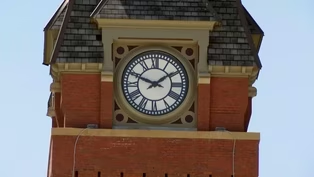
NewCongress Considers Bill to Make Daylight Saving Time Permanent
Video has Closed Captions
A bill in Washington would make daylight saving time permanent but faces an uncertain future. (9m 21s)
 New
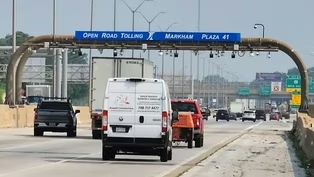
NewIllinois Tollway Moves Toward Big Toll Hike
Video has Closed Captions
The cost of driving the Illinois Tollway could go up next year as part of an infrastructure plan. (11m 18s)
Providing Support for PBS.org
Learn Moreabout PBS online sponsorship New Episode
- News and Public Affairs

Top journalists deliver compelling original analysis of the hour's headlines.
 New Episode
- News and Public Affairs

Today's top journalists discuss Washington's current political events and public affairs.


 New Episode
 New Episode
 New Episode
 New Episode
 New Episode


 New Episode
Support for PBS provided by:
Chicago Tonight is a local public television program presented by WTTW
WTTW video streaming support provided by members and sponsors.