
July 7, 2026
7/7/2026 | 55m 20sVideo has Closed Captions
Cardinal Blase J. Cupich; Nicholas Enrich; Joanne Lipman
Archbishop of Chicago Cardinal Blase J. Cupich sheds light on Donald Trump's public fight with Pope Leo. Nicholas Enrich covers the dismantling of USAID in his new book. Journalist Joanne Lipman discusses how anti-DEI backlash is causing corporations to "erase women" from their narratives. Ukrainian journalist Alyona Synenko shows how some Ukrainians are displaying resistance through fashion.
Problems playing video? | Closed Captioning Feedback
Problems playing video? | Closed Captioning Feedback
July 7, 2026
7/7/2026 | 55m 20sVideo has Closed Captions
Archbishop of Chicago Cardinal Blase J. Cupich sheds light on Donald Trump's public fight with Pope Leo. Nicholas Enrich covers the dismantling of USAID in his new book. Journalist Joanne Lipman discusses how anti-DEI backlash is causing corporations to "erase women" from their narratives. Ukrainian journalist Alyona Synenko shows how some Ukrainians are displaying resistance through fashion.
Problems playing video? | Closed Captioning Feedback
Where to Watch Amanpour and Company
Amanpour and Company is available to stream on pbs.org and the PBS app.
Watch Amanpour and Company on PBS
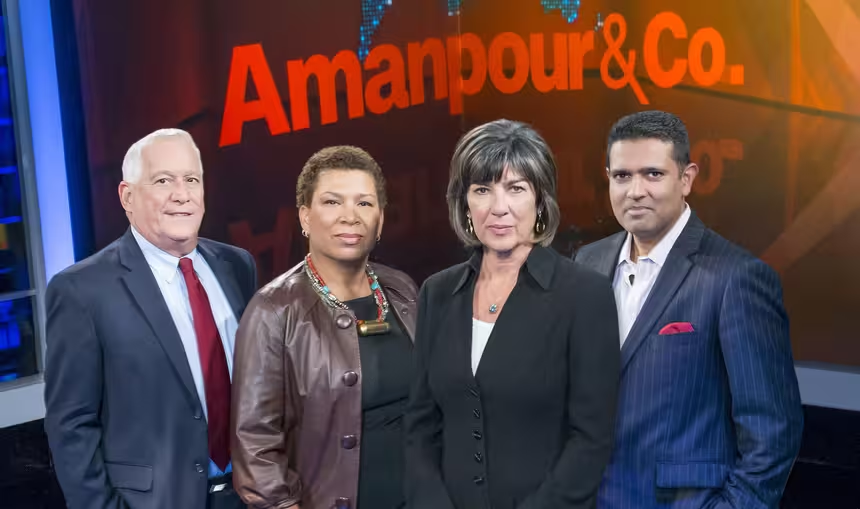
PBS and WNET, in collaboration with CNN, launched Amanpour and Company in September 2018. The series features wide-ranging, in-depth conversations with global thought leaders and cultural influencers on issues impacting the world each day, from politics, business, technology and arts, to science and sports.Providing Support for PBS.org
Learn Moreabout PBS online sponsorship(intense music) - Hello everyone and welcome to Amanpour and Company.
Here's what's coming up.
- Woe to those who manipulate religion in the very name of God for their own military, economic, or political gain.
- [Christiane] Pope Leo ramps up his war of words against President Trump as he promotes peace around the world.
I speak with the Pontiff's close ally, the Archbishop of Chicago Cardinal Blase Cupich.
Then "Into the Wood Chipper," a tell-all memoir about the shredding of USAID and the grave human costs.
Whistleblower, Nicholas Enrich joins me.
Plus... - There's a fear of even mentioning the word women, female.
- [Christiane] Are women being erased from the workplace?
Journalist Joanne Lipman tells Michel Martin, "Yes, they are due to White House rollbacks on DEI policies."
Also ahead defying war with fashion.
We hear about the Ukrainians keeping their spirits up with style.
(upbeat dramatic music) (upbeat dramatic music continues) - [Announcer] Amanpour & Company is made possible by the Anderson Family Endowment, Jim Attwood and Leslie Williams, Candace King Weir, the Sylvia A. and Simon B. Poyta Programming Endowment to Fight Antisemitism, the Straus Family Foundation, the Peter G. Peterson and Joan Ganz Cooney Fund, Charles Rosenblum, Monique Schoen Warshaw, Koo and Patricia Yuen, committed to bridging cultural differences in our communities, Barbara Hope Zuckerberg, and by contributions to your PBS station from viewers like you.
Thank you.
- Welcome to the program everyone.
I'm Christiane Amanpour in London.
God does not bless any conflict, the unwavering position of Pope Leo as he finds himself in an ongoing public dispute with the Trump administration over the war on Iran, which they justify often in biblical terms.
Today in Cameroon, midway through his 11 day visit to Africa, the pontiff's message was quite clear.
- War to those who manipulate religion in the very name of God for their own military, economic or political gain.
Dragging that which is sacred into darkness and filth.
Billions of dollars are spent on killing, on devastation.
The world is being ravaged by a handful of tyrants.
- The message is quite clear.
It comes after President Trump lashed out at Leo, calling him weak, adding that he prefers Leo's MAGA supporting brother.
The Pope has been firmly pushing back throughout, talking to journalists on the papal plane on Monday.
He said, "I have no fear of the Trump administration or speaking out loudly the message of the gospel.
For more on of this, I spoke to one of America's most influential cardinals, and Pope Leo's staunch ally, the Archbishop of Chicago, Cardinal Blase Cupich.
Cardinal Blase Cupich, welcome to our program.
- Thank you Christiane.
Good to be with you.
- Cardinal, you've probably obviously heard what the Pope said today from Cameroon, where again, he's laying down the gauntlet for peace.
But he talked about the opposite of that is being dragged into the filth.
He used the word filth.
He talked about tyrants and autocrats.
Tell me why this kind of escalation of words is happening.
- Well, I think it's in keeping with his obligation and his sacred mission of sharing the gospel.
And that I think is something that has always been a part of the church's teaching, that tyrants and those who wage wars really do harm to the common good.
Those teachings go back many years.
And so he's in keeping with that mission.
- Do you think, Archbishop, that Trump is right or the others in the administration are right when they think that Pope Leo is addressing him with these comments?
And is he?
- Well, I think that he's addressing the, as he says, the zeal for war, where war is now in vogue.
You know, as Pope Francis said, "It's being a world war that's being fought piecemeal."
And so the Pope, again is simply, you know, fulfilling his sacred mission of sharing the gospel.
And I would also say that comments that attack the Pope really are not about attacking one person, but attacking the church itself and its mission.
- Well, the attacks were pretty strong.
And I mean, honestly, I have covered, you know, the world for a long, long time.
I've actually never seen such an ad ho attack from the United States towards a pontiff.
Clearly there have been times when, let's say in Reagan's era there was, you know, John Paul II, there was the fall of communism in Poland and you know, then there was Pope Francis.
I guess what I'm trying to say is sometimes popes are viewed as more liberals, sometimes more conservative, but I've never seen this kind of public spat, I don't even know whether that's the right word.
What do you make of that?
- Well, for me, it has all the appearance of an organized effort to discredit and marginalize the voice of the Catholic church in the public square.
And it would be really sad if this turns out to be a new chapter in the sad history of anti-Catholicism in this country.
- You know, very interestingly, after Trump sort of went out the Pope for calling him weak, et cetera, the chairman of the US Catholic Bishops Doctrine Committee said, "For over a thousand years, the Catholic Church has taught just war theory.
And it is that long tradition the Holy Father carefully references in his comments on war.
It must be a defense against another who actively wages war, which is what the Holy Father actually said.
'He does not listen to the prayers of those who wage war.'
So when Pope Leo XIV speaks as supreme pastor of the universal church, he's not merely offering opinions on theology, he's preaching the Gospel."
So I just wanna first ask you about the concept of just war.
- Yes, so the concept of just war has always been defined by, you have to make sure that you have an objective that's clearly defined that's going to restore order and justice.
We've seen so many comments about this particular war in which the objective is not clearly defined because it jumps from one topic to the other.
But you also, I think in this modern era where you have weapons that can impact a wide range of innocent victims in a population, that we have to make sure that we understand that when you wage that kind of war with these weapons, you have to look at what damage you're doing to a society, to people who are innocent victims in a country.
And so there has to be a proportionality in the actions that are taken, but also very clearly defined goals.
- So do you then, and the Pope then does not believe this war is just as defined?
- No, it is not just.
- The other part of this statement that I read to you from your own conference of bishops basically refers to something that Vice President Vance had said, who himself is a Catholic, a convert to Catholicism.
He said, "The Pope should be more careful when talking about theology."
And this is what he said.
- On the one hand, again, I like that the Pope is an advocate for peace.
I think that's certainly one of his roles.
On the other hand, how can you say that God is never on the side of those who willed the sword?
Was God on the side of the Americans who liberated France from the Nazis?
Was God on the side of the Americans who liberated Holocaust camps and liberated those innocent people from, you know, those who had survived the Holocaust?
I certainly think the answer is yes.
When the Pope says that God is never on the side of those who will the sword, there is a more than a thousand year tradition of just war theory, okay?
Now we can, of course, have disagreements about whether this or that conflict is just, but I think that it's important, in the same way that it's important for the Vice President of the United States to be careful when I talk about matters of public policy, I think it's very, very important for the Pope to be careful when he talks about matters of theology.
- Your reaction to, "The Pope should be careful when talking about theology."
I thought that was his job, frankly, but I don't know.
- It is, you're right on target.
It is his job.
And to equate responding to the attacks against the United States that prompted the Second World War intervention on our part to what's happening here with this war of choice really falls short.
And so I think the logic just unravels when you look more deeply at the argument that he's making.
- And you know, every single day, including today, Pete Hegseth, he calls himself the... Actually, he calls himself the Secretary of War instead of defense.
And he quotes the Bible all the time.
Today, he decided to lash out of the press, calling us the Pharisees for not supporting the war.
Like the Pharisees who didn't support Jesus Christ when he came into the synagogue.
This is a reading that he made from the podium.
Let me just play it for you.
- I'll close with scripture, drawing strength from Psalm 144.
"Blessed be the Lord, my rock, who trains my hands for war and my fingers for battle.
He is my loving God and my fortress, my stronghold, and my deliverer, my shield in whom I take refuge."
- Can you parse all of that cardinal?
- Well, it's quite difficult to do so because as Holy Father said today, "Anyone who uses the scriptures and invokes God in a war that harms so many people and undermines social order and world stability," I think begins to go down a path that I can't really be supported.
If he's gonna quote scripture, I think going back to the Beatitudes and hearing Jesus say, "Blessed are the peacemakers," would be a good place to start.
- Cardinal, can I ask you what you think is the bigger picture here?
What is happening?
Because now we hear a report that's been broken by, I believe it's the "Miami Herald" says, "The White House is abruptly canceled $11 million contract with Catholic charities to shelter and care for migrant children who enter the US alone."
The Archbishop there says the government has abruptly decided to end more than 60 years of a relationship with Catholic charities in his archdiocese.
What do you think is going on?
- Well, that's why I said earlier that it really gives the appearance all of these actions and comments of an orchestrated effort, an organized effort to marginalize the voice of the church in the public square.
And I, again, hope that this is not the beginning of a new chapter of the sad history of anti-Catholicism that we have experienced in this country before.
And I think that it's time for people in the administration and in Congress to step forward and tell us exactly where they are.
- So the government says it's because the number of kids coming over has dropped significantly.
But I do wanna ask you this because, you know, "The New York Times" has gathered data and it sees that Catholic church converts have really expanded in the United States.
Churches across America are welcoming the highest number of new Catholics in recent years.
So you are obviously a force, and there has been a round condemnation by many of the Christian faiths, not just the Catholics, to a lot of what Trump is saying about the Pope, you know, the depiction of Trump himself as Jesus.
He says it wasn't, he said he was looking like a healer.
And Trump was brought in by, to an extent, the Christian evangelicals, they used him as their vessel they said.
- Well, it's true.
And on the other hand, a majority of Catholics voted for him as well.
I'm hearing, however, from a lot of people that they didn't vote for the indiscriminate mass deportation of people that we experienced here in Chicago and throughout the United States, and also that we would become involved in foreign wars.
So I think that it'll be interesting as time goes on to see what those numbers are today.
But I do think that, you know, again, getting back to what we're saying in the church here, is that this is not about politics, this is about the gospel.
And we wanna make sure that people have the language to talk about and think about what's happening today, not just in terms of politics or national gains, but rather to the higher motivations that we are called to as human beings to respect human dignity and the common good.
- And Father Archbishop, it's not an accident that Pope Leo is the first American pope.
He speaks obviously fluent English-American.
He's constantly talking to the press.
This is unprecedented really.
No other pope did that.
Every time he leaves his residence, there's a gaggle there and he says something.
You know, one might almost think that he was elected because of the historical moment that he's in to sort of be the moral voice in this situation right now.
And maybe took to actually, you know, speak from his platform against some of the Trump policies that he disagrees with.
- Well, we really firmly believe that as we elected him in the conclave, that there was a presence of God's Holy Spirit that was moving us in that direction.
But Robert Prevost came with a whole host of talents and experiences that recommended him.
He was a missionary, he speaks a number of languages.
He's traveled to over 40 countries.
He knows what it means to be a pastor.
He's one who has experience in administration.
So I think his abilities, but also our attention to the movement of the Holy Spirit as we went ahead with the conclave we're all responsible for his election.
- And I guess finally, because this is also a big deal in the United States, obviously this July 4th is the 250th anniversary of America.
The Pope has declined an invitation.
Instead he's going to minister to migrants, immigrants at Lampedusa in Italy.
Do you support that decision?
- Well, of course, because it's clear that he's showing that his priority is to reach out to those who are poor, those who are marginalized, who were forgotten.
And the fact that these are migrants fleeing either poverty or war and distress is really in tune with our American legacy that's inscribed on that tablet held by the Statue of Liberty.
So it's a very Catholic thing to do, but also a very American thing to do.
- And maybe a very American thing to do, finally, I want to ask you, I was struck by the words of Pope Leo when he said, "I am not afraid."
And we exist, I think, many people feel that they're in a environment right now, that if they speak the truth or speak their moral beliefs, they might face consequences.
Tell me about that, about the fear factor and sort of, you know, confronting fear.
- Well, I think that he responded to that in terms of whether or not he's going to continue speaking and speaking boldly.
And it's at that moment that he said, "I am going to do this.
I'm not afraid to do this.
And because it is my mission to preach the gospel."
And so I think that it's not just a matter of not being afraid, but it's also a boldness of spirit to make sure that he's true to his mission and obligation as a successor of Peter.
- Well, it is something very fascinating to watch and we really do appreciate you coming on to our show.
So, Cardinal Blase Cupich, thank you for joining us from Chicago.
- Thank you, Christiane.
Good luck to you.
- Now, as conflict and war spread around the world, humanitarian aid is simultaneously shrinking just it's most needed.
Many western countries are cutting back their international development funding, forced instead to focus on military spending and other national priorities.
All these cuts have real world impact, but none so grave as the destruction of USAID.
Nicholas Enrich spent decades working there, and he's now written a tell all memoir, "Into the Wood Chipper," revealing the chaotic way the agency was torn apart under the unelected Elon Musk.
And he's joining me now from Washington.
And Nicholas Enrich, welcome to the program.
- Thank you for having me.
- You know, I wanted to start with what it took to actually tell this story and be a little bit of a whistleblower.
I ended my conversation with Cardinal Cupich asking about fear and how Pope Leo actually has rejected the notion of fear in speaking out against what he considers this administration or any administration's unjust policies.
So did you have to sort of gather your strength and be a bit careful when you wrote this?
Were you worried about it?
- I did, I was intimidated for a long time, even though I told myself not to be.
But ultimately I found that I hit my breaking point.
And once I did, once I no longer felt like I could be silent as the agency that I had spent my career with, and that was being torn apart, it actually became a choice that I felt like I had no other option.
And so at that point, I decided that I needed to speak up and I needed to speak out.
And that's why I ended up writing memos to describe what was happening at USAID, how Elon Musk and his minions were tearing the agency apart while lying about it publicly, and the damage that that was gonna cause all around the world for years to come.
- Well, let's break that down a bit.
When did the alarm bells first go off?
IE, yes, they threatened it verbally from the beginning, but did you think at that time that it would lead to the shattering of USAID?
- Originally, no, the first alarm bell was the day of the elect, sorry, of Trump's inauguration when there was a freeze that went into effect on all foreign aid.
But I thought it must be a mistake because if it meant the way it was written, that would actually result in many people dying.
And I didn't believe that that would be the case.
But two weeks into the Trump administration, Elon Musk tweeted that he just spent the weekend feeding USAID "Into the Wood Chipper."
And I was the top global health official at USAID at the time.
So I then watched in real time as pretty much exactly what he said happened.
And the agency was shredded in the most cruel and indifferent way that you could imagine.
And so my book is my attempt to show what it felt like from inside of that wood chipper as our programs were destroyed, and the incompetence and ignorance of the Trump administration and the impossible choices that civil servants were forced into as our programs collapsed.
- You know, because it was such a dramatic thing and it went against the grain of the United States and what it stands for, Secretary of State Rubio obviously was challenged about it.
I remember reading about a, I think he was in Panama or something, Honduras or something, and the embassy staff challenged him about this.
And then he issued a waiver.
And you sort of described in your book feeling a sense of relief after this waiver, but it seems that the deluge just got worse after that.
What was the waiver?
I mean, I know it was designed to save lifesaving programs, let them stay, did it work?
And how were you feeling about when he made that waiver?
- Yes, when Rubio first issued the waiver for lifesaving humanitarian assistance, I was relieved.
This was the exception that we were expecting.
Of course, the administration didn't mean to let millions of people die as it was tearing down our agency.
At least they would keep those key programs.
But the reality turned out to be far from that, we were stopped at every point along the way from tearing down our payment system to ensure that our partners in countries could not work, to eliminating our experts who worked there to be able to implement our programs, to ultimately canceling all of the contracts that we needed to implement lifesaving work.
We were stopped at every turn, even as Elon Musk and Marco Rubio said that lifesaving programs were continuing.
- So you would then say, conclude that they were lying.
They were lying when they said that they would continue.
- They were lying when they said that they would continue.
And in fact, Elon Musk stood at the White House and said that Ebola activities had restarted or were continuing the same day that his DOGE minions were actually canceling the contract that was needed to implement the Ebola program.
And as I watched, that was one of the last straws for me that made me realize nobody knows what's really going on, and however bad people think that it is inside of this agency, it's actually far, far worse.
- Let me play this soundbite from Elon Musk goes to the heart of what you've just been talking about.
- So, and I should say, we will make mistakes.
We won't be perfect, but when we make mistake, we'll fix it very quickly.
So for example, with USAID, one of the things we accidentally canceled very briefly was Ebola prevention.
I think we all want Ebola prevention.
So we restored the Ebola prevention immediately and there was no interruption.
- Let's just say again, that was not the truth?
- That statement was completely inaccurate.
And it was his team that at the exact same time he was saying it, they were canceling the contracts that we would've needed to do the Ebola activities that he was saying we're restarting.
- So can I just ask you to, if I can sort of tell me, you know, the sort of the ledger, what has this led to?
It's led to deaths, has it?
It's led to certainly treatments and things being stopped, I know around the world.
But if you were to sum up what has happened to all these recipients of aid in the year that it's been shredded?
- Yes, well, the impacts have been clear and devastating.
To date, approximately 750,000 people, most of those children, have already died according to conservative estimates.
And unfortunately, I think the concern is that the worst is yet to come and that death and destruction will spread over time as a next generation grows up of children who did not receive immunizations that USAID used to provide, of babies that are born with HIV that over just a year ago, rates were near zero and now we're seeing rates in some clinics as high as 25%.
And so I think the damage and destruction that we will see over the course of the next several years will actually end up being one of the most impactful policy decisions that the Trump administration made.
- You know, when you say 750,000 deaths, it's just so shocking that it's hard to compute.
But certainly we've seen these figures and it is really very shocking.
Look, according to the, you know, the statistics, USAID essentially cost an average of $24 a year per American.
In other words, it wasn't some massive part of GDP and some massive part of the budget.
In fact, most Americans think the USAID was more and should be a certain percentage and it's much, much less than that.
Can you explain why you think these people wanted to gut it?
Was there a lot of, you know, waste, fraud, mismanagement, all of that kind of stuff?
Was there another way to be able to deal with whatever they were complaining about?
- Well, look, any organization and any federal agency could be made more efficient and USAID was no exception.
But we actually are talking about an organization that is known across the government as one of the most efficient of all the agencies.
For less than 1% of the federal budget, we saved over 92 million lives over the last two decades alone, which is just an incredible number when you think about return on investment.
However, even if there are ways to make the agency more effective and more efficient, that's not what this team came in to do.
These were, again, these were uninformed, these were unqualified individuals that some of them were vindictive, others were just confused and had no idea what the agency that they were trying to destroy even did.
- Hmm, and we all remember because we read about it and it's part of American history, that it was President John F. Kennedy who set this in motion as a way to expand America's influence and its soft power around the world.
It was a crucial element of American foreign policy and national security.
You obviously have written a lot about this, the personal impact on you as well, of essentially ending your civil service career.
And you've written about the disbelief you and your colleagues experienced as this agency was unfurling.
Do you have a passage that you want to read about that?
- Sure, yes, let me read just one paragraph.
- Yes, just a paragraph - On that very topic.
Thank you.
Okay, "Hustling back to my office, I passed through a hallway in upheaval.
Friends who had worked together for decades were crying and hugging, not knowing if or when they would see one another again.
Professionals who had spent their entire adult lives trying to make the world a healthier place, stared blankly, unsure of what they would be doing tomorrow or forever.
Was this really happening?
Were we witnessing the complete disintegration of American foreign aid?"
- And as you're reading, we're seeing these really sad pictures of your colleagues hugging on the last day of USAID.
So your career has ended, do you think it can be revived if another administration comes in that actually believes in the promise of soft power and certainly the moral imperative of helping people and humanitarian projection of power?
- I hope so.
I believe that we do need an independent agency for international development.
Perhaps there are ways to improve it and we could do it differently, but I do think that the agency needs to come back independently in the same way that we have a separate Department of State from a Department of Defense, because these are two separate pillars of foreign policy.
So too is international development.
And I think we need a way to embody American generosity because there's huge benefits for America and for the world.
- And you know what, Nicholas Enrich, as I say goodbye and thank you, you've reminded me of a key quote from Trump's first defense Secretary General Mattis, who said, "If you don't fund the State Department fully, then I need to buy more ammunition."
I think it's summed up incredibly well.
Thank you so much for being with us.
- Thank you.
- Now it's not just USAID and humanitarian aid that's been slashed, but the Trump administration is also slashing DEI efforts.
Our next guest warns this could reverse decades of progress for gender equality at work.
Joanne Lipman has spent decades reporting on workplace culture and gender dynamics, and she tells Michel Martin how some companies are ending or hiding their inclusion efforts and the chilling effect it's having on women.
- Thanks, Christiane.
Joanne Lipman, thank you so much for talking with us.
- Thanks for having me.
- You've written about women and work, gender and work for years now.
You wrote a recent essay in "The New York Times" where you argue that we are entering a moment where even talking about women at work is becoming taboo.
You open with the line, "Believe women with the defining message of the #MeToo movement.
Today, there's a new one: Erase women."
Obviously there's a lot to talk about here, but what made you say that?
Was there something in particular that caught your attention, that made you feel that?
- Sure, yeah, so Michel, I've been covering women in the workplace for more than 15 years and I've also been an editor and editor-in-chief of several different publications and have assigned a lot of coverage of women in the workplace.
And I noticed something different that's happening now, and that is because I've been covering these issues, my inbox is usually filled with companies that are talking about all these great initiatives that they have and they wanna boast about it and how well they're doing.
And suddenly, not only did they stop doing that, now they're afraid to talk about it.
- You have an anecdote in your piece where you described asking a room full of HR executives whether their companies were still supporting diversity efforts and you said every hand goes up.
And then when you ask who would talk about it publicly, and you saw almost every hand go down, which is kind of wild.
- Yes, and so I talked to some of these people privately, and I've talked to executives at some major companies that in the past have been banging their chests about how great they are with diversity.
And as one of these executives said to me, they said, "You know, there's fear.
It's fear both because of all the anti-DEI measures that are coming down from Washington, but also fear of right wing activists, fear of misogynistic trolls."
And so there's a fear of even, you know, raising your hand a little bit, there's a fear of even mentioning the word women, female.
And so people don't wanna talk about their efforts at all.
And it's led to some absolutely insane kinds of evasions that we're seeing.
So for example, there's a medical newsletter that actually advised its readers to strip out the words female or women from any of their research grants.
Even those that have to do with women, obviously.
There was actually an example of a researcher who was looking at maternal mortality who felt like they had to strip out references to women in order to get federal funding for that.
- So there are people who have made this point before, but they're arguing that this is just kind of a brand pivot, that this isn't really substantive.
Do you know what I'm saying?
That some people say it's a rhetorical or a branding shift, but it's not a substantive rollback.
- Well for sure there are people who are, and organizations that are still committed to equity and to diversity that are rebranding their programs.
The issue is that because of the fear that is out there, we're also seeing literal rollbacks, we're seeing real impact because of that, right?
We're already seeing, you know, the wage gap has increased, the gender wage gap has increased per two years in a row.
We're seeing women disproportionately, particularly mothers of young children who are leaving the workforce.
And we're seeing some pretty alarming things that are coming actually from the administration.
Like for example, the United Nations has every year puts out this sort of statement about women inequality and 35 nations sign off on this thing every year.
It's very anodyne.
It's basically we believe in not having legislation against women, right?
It's pretty basic.
And for the first time ever, the United States refused to sign off on it, calling it gender ideology.
- You pointed the great exit of mothers of young children from the workforce that... Are you sure that this is due to this kind of sort of atmosphere of erasure that you're talking about?
Or could it be due to other factors like Covid for example?
I'm curious like what evidence do you have?
Is that, as opposed to sort of other factors that aren't really driven by any one person or entity or point of view?
- Oh, absolutely.
So let's like, take a step back for a second.
So during Covid, women disproportionately left the workforce.
Then when kids went back to school, people started working remotely, women poured into the workforce.
And we actually had a historic high number of women in the workforce that was propelled by mothers of young children who wanted to work, who could work or who needed to work, who were able to work in a way that they were not able to before because of the ability to work generally hybrid, remote, not fully remote, but hybrid remote was, you know, a huge plus.
Now what's happened is, in that case you have the situation where one of the first executive orders to come out of this administration was that everybody has to be back at work five days a week.
And that gave the excuse to an awful lot companies out there to say, "Okay, everybody has to be back in the office."
And that's the primary issue for mothers with young kids.
But I wanna go back to this issue of erasure 'cause I think what we're seeing is something I have not seen before, or we haven't seen it in many years, which is there's an embarrassment to talk about and a fear of talking about women, period, because it makes you a target.
So we've seen, you know, yes, we've seen this is top down administration where you've seen Trump allies who blame women for everything.
You know, they're blamed for the California wildfires, they're blamed for the Potomac plane crash, you name it, women get blamed.
Pete Hegseth has been firing female officers.
But what concerned me was actually less that and more of the bottom up.
What we're seeing is organizations that are afraid to even utter the word "women," to talk at all about women, for fear that they will be targeted.
So they're actually going further than they need to, further than what the administration is asking them to do.
There are organizations that are defunding things like these employee resource groups, which are groups centered on, you know, people who are women, people of color, LGBTQ people.
These groups are perfectly legal as long as anyone can join, which is the case for most of them, but they're getting defunded and even closed down because companies are afraid that simply having them will make them a target.
And I think that is what really concerned me.
What actually got me started on this was I was just interested in how women in the workplace were doing a year after the administration started cracking down on DEI, on diversity, equity and inclusion.
And actually at first I thought we would find some positive results because there's a lot of organizations that maybe did away with the scholarship or the training program that's only for women.
But they opened up other programs that are actually for everyone, but disproportionately help boost the fortunes of women and people of color.
Things like mentorship programs that are open to everyone, things like childcare, which actually helps men as much as it helps women, childcare assistance.
And there was a wonderful piece in "Harvard Business Review" by a couple of sociologists and they wrote this piece naming several companies and programs that they had put in place that were for everyone and had very positive outcomes for women and people of color.
And they named a couple of companies including IBM, Walmart, the Gap.
And I thought this is really interesting.
And so I called all of those companies to say, "Hey, can you elaborate on that?"
None of them wanted to talk about it.
- But at least they're doing it.
I guess, which leads me to my other question here, which is, is there a substantive result of not wanting to talk about women or taking women as a sort of subject of concern off the table?
- What we found so far is it's, you know, it's early days, but what we're seeing so far is, you know, we're no longer reporting a lot of the numbers.
So it's a little bit hard to tell.
Major companies have stopped.
They used to talk about workforce diversity data, the share of S&P 500 companies that discloses how many women are on their boards has fallen by about a third.
The companies that used to share ethnic, racial and gender diversity of their workforces and importantly of their workforce divided by job level, so you can see how many people are in management, they've stopped reporting it.
So we're a little bit flying blind to see what's happening here.
The problem is if you're not seeing it and you're not talking about, it's very, very easy for that progress to reverse.
And I noticed, for example, McKinsey and Lean In every year they put out a report on women in the workforce.
And first of all, I noticed this year the number of participants fell by more than half, even though the participants companies are anonymous, that still fell by more than half.
The corporate equality index, same thing.
Participants fell more than in half.
And even so, the Lean In McKinsey report found that women felt like they had less support and fewer career opportunities.
So again, I think what I would say on the positive side is there are lots of programs that corporations can embrace that are perfectly legal, that are out there for everyone that actually have a really positive impact.
So we don't have to have a decline in the opportunities for women and for people of color.
But, you know, if you don't count it, if you don't talk about it, it's really easy to backslide.
- The irony of course of all this is that, you know, President Trump, on the one hand, he's given women a number of important really critical roles in his administration, but they were also the first people he fired when he was... I don't know, it's kind of interesting to contemplate - The conversation at the top is one thing, but the fear that is really leading to this backlash against anything having to do with women is really concerning.
I mean, you see universities that no longer will talk about the Women's Center, they will talk about cultural centers maybe, but they're taking out words like "women."
You know, I look at all the organizations that used to support, used to see all the ads for Women's History Month, you would be forgiven if you didn't even know we just finished Women's History Month because it was so quiet.
There were, I think it was Ohio University that had every single year this big, you know, celebrating women event and they canceled it at the last minute.
So, you know, what we're seeing is I think very concerning for what might happen.
- Playing devil's advocate here.
Is it really wrong for publicly facing organizations, publicly traded organizations to be responsive to the political environment.
Because this administration has made it very clear that they will seek retribution against entities that they don't like.
- So there's a difference between companies that are continuing to do the work of diversity, not talking about it, versus those who are going further than what is being asked of them, right?
Companies that are doing things that are perfectly legal, people, researchers, medical researchers who are doing things that are perfectly legal and yet are feeling that they can't even talk about things that are legal.
In other words, they are going further than what is being asked of them.
I will also say that we saw a tremendous amount of performative nonsense out of companies, and that has definitely gone away.
So, you know, one of the interesting issues is that particularly after the 2020 murder of George Floyd where companies came out, they committed billions of dollars.
They made big grand sweeping statements and many of these companies were really, it was performative.
They were over their skis and promising things they were not gonna deliver.
They were pouring money into things that really had zero impact.
And a lot of that has gone away.
And that's all for the good.
I think the organizations that are still committed to diversity are still doing it.
They're still committed.
They're just doing it quietly.
- So who should be called out in your opinion?
- I do think that organizations that are going way too far, that are retreating more than they have to are putting the rest of us in a fraught and potentially dangerous position.
I heard from so many people after this piece came out who are like, "Who's gonna stand up to this?"
Right?
And we have seen that organizations that do stand up when we've seen it in other arenas, when we've seen it with law firms that have stood up, in some of the universities that have stood up to some of these pronouncements or attacks that have gone too far and they've been successful.
And there are companies, there are large companies that are still committed to a diverse work workforce, equality, which doesn't mean giving preference to women or to people of color.
It simply means giving preference to talent and not firing because of their race or ethnicity or gender.
- So collective response is difficult unless you sort of find people who agree with you about sort of these sets of issues.
But individually, are there things that people could be doing?
- So, yeah, so first of all, I wanna say that this is not a women issue.
This is really a society-wide issue and also a democracy issue.
I mean, at heart this is a democracy issue, right?
That is, if you look at the autocrat playbook, which many scholars have talked about, one of the major features, tenets of the autocrats playbook is the repression of women, the erasure of women.
And the reason is that when women mobilize, and women are obviously a little more than half of the population, and when they do mobilize, they tend to mobilize in the direction of egalitarianism and democracy.
And so it's really important for the autocrats to put that down.
And that's also related to this issue of prentalism that we're seeing that women shouldn't be working, they should be at home and having their kids, et cetera.
So I would say that the premise that this is a woman problem, I would reject.
- Before I let you go, Joanne, as a person who sort of covered the business environment for years, what's your argument to companies about why this isn't their best interest to do, not just to resist, but to just to do what they actually say they were doing before, which is to, you know, open the doors and make sure that the best people have an opportunity to thrive and contribute.
- First of all, can I just emphasize exactly what you said?
The best people, you want the best people.
And every piece of research shows you that diverse organizations outperform homogeneous organizations.
There's been like years and years of research on this at this point.
Return on equity, profitability, employee retention, creativity, innovation, every single one of those things improves with diverse workforces.
There was even a piece of research that found that a diverse group will more accurately solve the murder mystery, a murder case than a homogenous group.
So we know, I mean, I really believe that every CEO, every CFO, chief financial officer, it is in their interest and they should be held to because we know that the diverse organizations perform better.
- Joanne Lipman, thank you so much for talking with us.
- Thanks for having me.
- Just a thought, Iceland 50 years ago had all women go on strike.
They didn't call it strike, but on the home front and on the work front, women downed tools.
Ever since, Iceland has had a correction in place that's made them one of the most equal and productive societies in the world.
Just a thought.
And finally for Ukrainians, an endless reign of death and destruction that never lets up.
Just last night, Russia launched one of its largest attacks this year, killing at least 18 people and wounding more than a hundred across major cities, including Kyiv, Kharkiv, and Odessa.
But everyone does what they can to try to survive and even thrive.
Some older residents in Odessa are channeling their defiance through their outfits.
In a recent essay for "The New York Times," writer and aid worker, Alyona Synenko profiles these stylish civilians and she's joining me now from Odessa to discuss finding joy in a time of war.
Alyona, welcome back to our program.
We've spoken before when we were both in Kyiv and it's really, I wanna ask you first, because the pictures of what happened last night, you were living it.
How are you after the terrible barrage?
- It was a terrible night for everybody here and other places and we did manage to sleep, but unfortunately this night it was just one among many others.
This has become a routine and just jumping out of bed in the middle of the night and running to hide between the two walls or in a shelter is just what everybody does here.
So our expectations are getting lower every day.
If you wake up in the morning and your building is still standing, then we still consider it a good night.
- Yeah, Alyona, you know, it's really incredible to hear you say that and that's why I was so blown away by the essay and the photos you displayed of many residents of Odessa, particularly elderly ones, really trying to have a good day under this terrible condition.
And they are just joyful pictures, that we're gonna show, of people dressing up in their best, best outfits.
How did you come across it?
Did you suddenly notice everybody getting dressed up or what made you focus on it?
- The photographer who took pictures, Olga Engibarova, she has been investigating and following this subject of this peculiar style of Odessa for many years.
And she has a blog that calls Odessa Style.
But besides the clothes, the clothes is part of the culture and identity.
Odessa is a port, it's a southern city.
It's a place where traditionally there's been a lot of mix of different cultures, different languages, and this diversity and this southern sun and the sea produce this very peculiar culture and the visual identity as well.
- The piece you wrote, "To Dress Up is to Live."
So let's talk about one of the elderly ladies, Violeta Eva, she is 94 years old, you interviewed her.
And you described her as one of the best dressed people you've ever seen.
Tell us what she told you about why she does it.
- Her answer was very simple.
First, she's not just one of the best dressed people I've ever seen, she's one of the most incredible people I've ever seen.
This woman is such an inspiration and brings so much joy and I'm so privileged and lucky to have met her.
She survived the Holocaust in Odessa.
She still remembers the city and the horrors that happened under Romanian occupation during the Second World War.
She told me stories about how she learned to sew and how as a very young child, she cut her mother's dress, her mother's only good dress to make herself a dress.
And from that time on, her mother told her that, okay, well now you will just have to make your own clothes.
And she's been making her own clothes all her life.
She's an engineer, she has lived an incredible life and just seeing this spirit, this style, this elegance, it's a privilege.
And honestly, I take a lot of inspiration from her.
- Yeah, it really is incredible.
And it's not just the women, it's the men as well.
You profiled 74-year-old Anatolii Padalka, he hardly leaves his house, you said, except to walk his dog.
But when he does, it's quite a presence.
- Yes, Anatolii is a personality.
He used to be an actor and he's known in the city.
A lot of my friends known him.
A lot of generations of people from Odessa know him.
And again, it is a lot of inspiration to see these people because when you see them, they just brighten up your day.
And we haven't had a lot of things happening around here to lift our spirits lately.
So seeing them, I think we can learn a lot from them.
But also hearing them, because when you sit down and talk to them, some of the things that they say about their experiences and about how they see things, again, it inspires me a lot.
- I was gonna ask you, you said it a little bit about how it inspires you, but how do the general public, when they see these, you know, incredibly well dressed, dignified people, I mean essentially reclaiming their humanity in the midst of this war.
How does it affect them and do they tell you how they survived the previous wars?
Can they help you like that?
- For me personally, they certainly have because I mean, we've had a terrible night, but we've also had a terrible winter without electricity, without heating in sub-zero temperatures.
So for me, sometimes there's just no hope.
There are no any meaningful peace negotiations, no diplomatic efforts.
And every day is just getting worse and worse and worse.
And sometimes there's just, you think, "How am I going to get through another day?"
But then when I met Violeta and she told me about how she saw people hanged in the middle of the street during the Second World War, how she spent several years hiding with your mother in the cellar.
And then I was like, I look at her and I think, "Well this woman survive and she had an amazing life, and who am I to sit here and just whine about how difficult our life is because we are not experiencing a fraction of what they have lived through.
- Amazing.
It's an amazing story.
Thank you for bringing that to us.
Thank you so much, Alyona Synenko.
And that's it for our program tonight.
If you want to find out what's coming up every night, sign up for our newsletter at pbs.org/amanpour.
Thank you for watching and goodbye from London.
(dramatic music)
 New Episode
- News and Public Affairs

Top journalists deliver compelling original analysis of the hour's headlines.

- News and Public Affairs

Today's top journalists discuss Washington's current political events and public affairs.


 New Episode
 New Episode
 New Episode
 New Episode

 New Episode
 New Episode
 New Episode
Support for PBS provided by: