
June 2, 2026 - PBS News Hour full episode
6/2/2026 | 57m 46sVideo has Closed Captions
June 2, 2026 - PBS News Hour full episode
Tuesday on the News Hour, Trump taps housing official Bill Pulte as acting director of national intelligence despite having no background in intelligence. Ukraine works to gain battlefield momentum after years of stalemate against Russia. How the Trump administration’s immigration crackdown is affecting colleges and students. Plus, why Sting continues to push himself in new creative directions.
Problems playing video? | Closed Captioning Feedback
Problems playing video? | Closed Captioning Feedback
Major corporate funding for the PBS News Hour is provided by BDO, BNSF, Consumer Cellular, American Cruise Lines, and Raymond James. Funding for the PBS NewsHour Weekend is provided by...
June 2, 2026 - PBS News Hour full episode
6/2/2026 | 57m 46sVideo has Closed Captions
Tuesday on the News Hour, Trump taps housing official Bill Pulte as acting director of national intelligence despite having no background in intelligence. Ukraine works to gain battlefield momentum after years of stalemate against Russia. How the Trump administration’s immigration crackdown is affecting colleges and students. Plus, why Sting continues to push himself in new creative directions.
Problems playing video? | Closed Captioning Feedback
How to Watch PBS News Hour
PBS News Hour is available to stream on pbs.org and the free PBS App, available on iPhone, Apple TV, Android TV, Android smartphones, Amazon Fire TV, Amazon Fire Tablet, Roku, Samsung Smart TV, LG TV, and Vizio.
Providing Support for PBS.org
Learn Moreabout PBS online sponsorshipGEOFF BENNETT: Good evening.
I'm Geoff Bennett.
Amna Nawaz is on assignment.
On the "News Hour" tonight: President Trump taps one of his current housing officials, Bill Pulte, as acting director of national intelligence, despite having no background in national intelligence.
Ukraine works to gain battlefield momentum after years of stalemate against Russia's invasion.
The Trump administration's hard-line immigration crackdown begins to affect college enrollment and student performance.
EVA SKIPWITH, Student, Augsburg University: It's exhausting to have to be on guard all the time, to have to worry about whether or not you're going to be taken from the only home that you know.
GEOFF BENNETT: And a sit down with Sting, why one of music's most enduring artists continues to push himself in new creative directions.
(BREAK) GEOFF BENNETT: Welcome to the "News Hour."
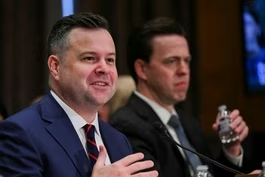
President Trump today named Bill Pulte, the head of the Federal Housing Finance Agency, as acting director of national intelligence, replacing Tulsi Gabbard.
Pulte, a loyal Trump ally who has frequently targeted the president's political opponents, has no background in national intelligence.
As acting DNI, he will oversee the nation's 18 intelligence agencies while also keeping his current role as a housing official.
That's according to Mr.
Trump's announcement on social media.
The appointment drew swift criticism from Democrats, while the Senate's top Republican also raised concerns about the selection.
We're joined now by White House correspondent Liz Landers.
So, Liz, Mr.
Pulte currently heads the agencies that deal with housing and mortgages.
What more should we know about his background?
LIZ LANDERS: He comes from this homebuilding empire, the Pulte Group.
He's a Floridian by birth.
He's relatively young at 38 years old.
And, as you mentioned, he's currently the head of the Federal Housing Finance Agency and the chairman of Fannie Mae and Freddie Mac.
It's not clear what his intelligence background is.
And, today, Dr.
Mehmet Oz, the CMS administrator, briefed reporters in the White House Briefing Room today, and myself and three other reporters asked about his qualifications.
Here is our exchange.
Congressional statute says any appointee for the position of the director of national intelligence shall have extensive national security expertise.
What extensive national security expertise does he have?
DR.
MEHMET OZ, Administrator, Centers for Medicare and Medicaid Services: Ma'am, you're asking me a question that's out of my lane.
I'm so focused on making sure Americans are healthy that I had not been looking at what other agencies do.
(CROSSTALK) LIZ LANDERS: Now, Dr.
Oz says that he trusts the president's judgment in appointing Mr.
Pulte to this role.
And President Trump defended this pick on TRUTH Social writing today that Pulte has -- quote -- "deep experience managing the most sensitive matters in America, the safety and soundness of the markets and over $10 trillion at Fannie Mae, Freddie Mac."
GEOFF BENNETT: So, Bill Pulte, as we said, replaces Tulsi Gabbard, who fell out of favor with President Trump.
What is Pulte's relationship with the president like?
How closely have they worked together?
LIZ LANDERS: By all accounts, Pulte has worked to build a close relationship with Trump in -- with President Trump in this role as the housing czar.
We spoke with him, a group of reporters, outside the West Wing in January.
And one of the things that he was talking about at that moment was pushing investigations into the president's perceived political enemies, like New York Attorney General Letitia James and Lisa Cook.
Listen to what he was saying then.
BILL PULTE, Director, Federal Housing Finance Agency: I can only speak to the mortgage fraud allegations, which is, I believe she's guilty as hell.
She's crooked.
In the case of saying that something's going to be her secondary residence when it's an investment property, this is not stuff that we can have in the mortgage market.
And Letitia James is one example, but Lisa Cook would be another.
LIZ LANDERS: That comment was about the New York attorney general there, but also Lisa Cook, who has served on the Federal Reserve, has been a target of the president, and he has tried to fire her.
The New York Times has reported that, over the past year, Pulte has rubbed Justice Department officials the wrong way by pushing for these kinds of prosecutions.
He's also aligned himself with Ed Martin, who is a far right activist who ran the Department of Justice Weaponization Task Force for a time period.
GEOFF BENNETT: So what has the reaction been across Washington today?
LIZ LANDERS: There are questions about this pick, and especially on Capitol Hill.
Usually, there's a rigorous confirmation process.
Tulsi Gabbard went through that when she was confirmed for this role.
Democratic Senator Chris Coons told our Hill team this earlier: SEN.
CHRIS COONS (D-DE): To put someone whose only qualification is his demonstrated willingness to help President Trump pursue his political enemies is risky for the American people and should be opposed by the Senate.
LIZ LANDERS: And, as you mentioned, the Republican majority leader in the Senate, John Thune, is also raising questions about this.
He told reporters this morning -- quote -- "We don't need a weaponized DNI.
We need professionals there.
If he's somebody we want in that position permanently, he's got a lengthy road ahead of him."
Also, Senator John Cornyn, a Republican from Texas, told our colleague Lisa Desjardins: "I see no evidence of any qualifications for that job."
But, Geoff, I spoke with one Trump ally, who told me that we have seen people appointed to administrations, Democratic and Republican administrations, where people may not necessarily have the exact qualifications for the role, but they have the trust of the president.
This person said that, for Trump, the trust credential weighs much higher than in other administrations -- Geoff.
GEOFF BENNETT: All right, Liz Landers, our thanks to you, as always.
LIZ LANDERS: Of course.
GEOFF BENNETT: We turn now to another Trump administration proposal that has drawn criticism from lawmakers on Capitol Hill.
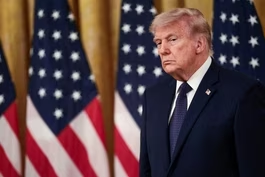
Acting Attorney General Todd Blanche said today that the Justice Department is scrapping plans to create that $1.8 billion so-called anti-weaponization fund.
It's a setback for President Trump after Republican senators made clear they did not have the votes to advance a Homeland Security funding bill unless the White House either scaled back or scrapped the fund entirely.
We're joined now by our congressional respondent, Lisa Desjardins.
So, Lisa, start by walking us through what the administration is proposing here.
What happens to this proposed fund?
LISA DESJARDINS: This is news.
We have just been getting this in the last couple hours from acting Attorney General Blanche himself, and it is the most clear statement that we or Congress has gotten about the future of the fund.
Listen to what the acting attorney general told Congress.
He said very clearly this fund is not moving forward.
TODD BLANCHE, Acting U.S.
Attorney General: The reasons for the fund, I think, were -- remain as important as they were before, but we are not moving forward with the fund.
REP.
GRACE MENG (D-NY): Not moving forward ever?
TODD BLANCHE: Correct.
LISA DESJARDINS: Now, Senate Republican sources tell me their understanding from the White House is that no money will be disbursed from this.
But, of course, this doesn't really answer all the questions we have.
Among them, remember, this comes from a three-part settlement that President Trump personally had with his own administration.
So I want to go through that settlement.
One, that $1.8 billion anti-weaponization fund is out.
What is still in, however, is a retroactive immunity deal with the IRS for President Trump, his sons, and his businesses.
Also still in, a formal apology that he expects from the U.S.
government.
There are still lots of questions, including the -- one, the idea that Mr.
Blanche today refused to put in writing that the fund is on hold.
He said his word is enough.
In addition, we don't know if any money is changing hands, if there have been any other changes to this settlement.
We're waiting to hear from the Trump Organization.
Finally, remember, Enrique Tarrio, that January 6 man who's convicted for helping plan it, told our Liz Landers he thinks there will be other options, other ways that the Trump administration finds money for people like him.
Is that still possible?
We have to watch.
GEOFF BENNETT: So, Blanche, who used to be President Trump's personal attorney, he's saying, take my word for it.
Is that enough to satisfy skeptical Republicans?
LISA DESJARDINS: You know, I think a month or so ago, the answer would be yes.
It's not right now.
They're carefully parsing this.
Talking to Senate Republican sources in the last hour, they're digesting this, but they do say the fact that he said this under oath, publicly, that that is a step forward for Republicans.
However, Democrats have major problems.
They have a lot of questions, especially about that immunity deal that the president got and his sons.
So expect that to continue to come up a lot.
GEOFF BENNETT: And, Lisa, this White House has in the past generally been able to bring Hill Republicans into line on its major priorities.
The fact that they weren't able to do that on this, what does that suggest?
LISA DESJARDINS: I think about this so much.
For the first 18 months, as you say, I saw Republicans in Congress go along with nominees that they in truth did not support and told me behind the scenes.
They turned the other cheek as they saw NATO allies threatened.
Tariffs were a bother to them, did not raise problems with it for the most part.
But now we're in a situation where, think about what's happened.
Trump has ousted Republicans in Congress, including two senators in just the last couple of weeks.
And they have begun to draw lines about that.
So what you get from that is that you see Leader Thune in the Senate and the speaker in the House telling them this week that their members just are not on board with this fund.
But you can see they're still in a tricky position, as we heard from Majority Leader Thune as he spoke to reporters today.
SEN.
JOHN THUNE (R-SD): We rely on the president, as does the House of Representatives, to help make sure that he's doing everything he can to help us move our agenda forward.
And he continues to do that.
We continue to listen to his advice and counsel and do everything we can to help the country succeed.
Because I think, in the end, that's what the American people expect, and, frankly, that's what our jobs are all about.
LISA DESJARDINS: I stood there listening to that, and I felt like that entire thing was for President Trump, to say, we still think you're great.
We still think you're great.
But they did draw a line.
And that is something new.
Will they draw more lines?
We will watch as we see more votes on the Iran war.
GEOFF BENNETT: And where does this all leave the administration's larger immigration agenda, namely, ICE funding?
LISA DESJARDINS: Right.
It was stuck completely on this issue.
I can't say it's all the way on track yet, but it might be getting there soon.
Senator Kennedy this morning described that just a couple hours ago to me as a broken arm with a bone sticking out of it.
Now it looks like the arm has been put in a sling.
Maybe it'll get back on track.
And that's important because there are other major bills ahead, including on intelligence, that the Senate needs to deal with in the next week or so.
GEOFF BENNETT: A busy day.
Lisa Desjardins, tracking it all, thanks so much.
LISA DESJARDINS: You're welcome.
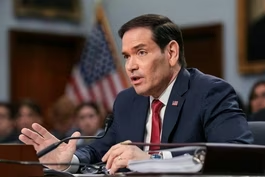
GEOFF BENNETT: In the day's other headlines: Secretary of State Marco Rubio told lawmakers today that talks indeed are continuing with Iran and that the regime has engaged as never before on the issue of its nuclear program.
MARCO RUBIO, U.S.
Secretary of State: They have agreed to negotiate aspects of their nuclear program that just a month ago or just a year ago they were refusing to even mention, much less enter into discussions about.
GEOFF BENNETT: Secretary Rubio was speaking during his first appearance before Congress since the Iran war started.
His assurances came despite Iran's claims that it has stopped all dialogue with the U.S.
through regional mediators.
Democrats on the Senate Foreign Relations Committee took aim at Iran's closure of the Strait of Hormuz, saying it gives Tehran the upper hand in talks.
SEN.
CORY BOOKER (D-NJ): We have made our adversary in a stronger negotiating position.
We are the strongest nation on the planet Earth and we're in a stalemate with Iran.
And now we're begging to get back into a deal that you all trashed in the first place.
MARCO RUBIO: We're not begging.
There's no one begging.
I don't know where you're getting this perception that Iran is stronger.
GEOFF BENNETT: Rubio also said in his testimony that U.S.
negotiators have seen signs that Iran's new supreme leader has been engaging with the talks, though only through intermediaries.
Meantime, Israeli drone strikes killed at least 11 people in Southern Lebanon today, just one day after President Trump said Israel and the Iran-backed militant group Hezbollah had agreed to dial back the fighting.
This hospital complex in the southern port city of Tyre was damaged in the attacks.
Some of its windows were blown out and equipment was scattered on the floor, but medical staff there are vowing to carry on.
KHADIJA YOUSEF, Nurse, Jabal Amel Hospital (through translator): We were on duty working.
I heard a very loud sound, a very big explosion.
I screamed from the bottom of my heart and I immediately told my colleague to go check on the patient.
We were more worried about the patients than ourselves.
GEOFF BENNETT: The strikes come as Israel and Lebanon begin a new round of direct talks at the State Department in Washington, D.C.
Hezbollah has not taken part in such talks.
A court in Kenya is extending for at least three weeks its block on a proposed quarantine facility for Americans exposed to Hezbollah.
The planned facility sparked public anger with protests, starting on Monday and spilling over for a second day today.
Organizers say at least two people have been killed in the unrest.
Last night, Kenya's president defended the facility in a briefing with journalists, saying it's part of a longstanding health partnership with the U.S.
WILLIAM RUTO, Kenyan President: I am very confident about what we are doing as a country.
I can assure the people of Kenya Kenya that the agreement between the government of Kenya and the American government is for the good of our country.
GEOFF BENNETT: Also today, the World Health Organization slashed the number of suspected cases in the Democratic Republic of the Congo to 116.
That's down from more than 900 as of a few days ago, as authorities rule out hundreds of possible infections.
President Trump signed an executive order today that asks A.I.
companies to give the government early access to their models in order to assess their national security risks.
The long-awaited order allows the government up to a month to review new models before any public release.
It's the administration's biggest step yet towards regulating A.I., but it stops short of forcing companies to comply.
Mr.
Trump signed today's order behind closed doors less than two weeks after he scrapped a similar order, amid fears it would hurt the nation's competitive edge in artificial intelligence.
The White House Correspondents' Association says it has rescheduled its annual dinner for July 24 after a gunman attempted to storm the event during the original gathering back in April.
President Trump said today he plans to attend.
The previous dinner had just started when authorities say Cole Tomas Allen attempted to breach security and enter the ballroom.
Allen faces four felony charges in connection with the incident, including attempted assassination of the president.
On Wall Street today, stocks climbed higher amid ongoing optimism over artificial intelligence.
The Dow Jones industrial average added nearly 230 points.
The Nasdaq rose just seven points, so nearly flat.
The S&P 500 also posted a modest gain.
Still to come on the "News Hour": how Ukraine is shifting the momentum with Russia with technological innovation; we examine the impact of the Trump administration's immigration crackdown on college students; and Sting talks about his long career as a singer-songwriter and pushing his artistry into new forms.
Russia launched massive overnight attacks across Ukraine, but focused again on the capital, Kyiv.
Nationwide, at least 22 people were killed, more than 130 wounded.
Russia has stepped up the size and pace of its attacks on Ukrainian cities in recent months.
But, as Nick Schifrin tells us, on the battlefront, Ukraine is trying to turn the tide.
NICK SCHIFRIN: This morning in Kyiv, the attack Ukraine had feared.
Russia rained down a massive strike, leading to thunderous explosions.
Across several cities, more than 70 missiles and 650 drones lit up the predawn sky.
By day, walls became windows into what used to be a family's home, a child's drawings thrown by a direct Russian strike into their parents' bedroom, the kitchen and a family's memories ruined.
In this building, at least three people died.
And across Kyiv, the attack sparked fires in the middle of residential neighborhoods, entire apartment buildings battered and blackened, a scene that residents called hell; 35-year-old Olha Mudra pointed to her destroyed apartment and her daughter, saved by her mother's protection.
OLHA MUDRA, Kyiv, Ukraine, Resident (through translator): We heard a sound, and then everything was in smoke.
We crouched down.
I covered my daughter.
We couldn't understand if it was the apocalypse or what.
NICK SCHIFRIN: Olena Dniprovska left shell-shocked, she and her cat in need of comfort.
OLENA DNIPROVSKA, Kyiv, Ukraine, Resident (through translator): Now I have nowhere to live.
The apartment is completely destroyed, no doors, no windows, no balcony.
The exit is right from the room onto the street.
NICK SCHIFRIN: The attacks followed more than a week of Russian threats that diplomats and foreigners should flee Kyiv.
And, in recent weeks, Russia has expanded its punishment of Ukraine's cities, unleashing some of the war's largest strikes.
Ukraine does not have enough Western air defense, including American Patriots, to protect its cities and critical infrastructure, leading to a renewed request tonight from Ukrainian President Volodymyr Zelenskyy.
VOLODYMYR ZELENSKYY, Ukrainian President (through translator): All partners together and everyone in Europe must continue working to ensure Ukraine receives air defense missiles, the necessary systems, vital intelligence, and other resources that help save lives.
NICK SCHIFRIN: But despite the bombardment, Ukraine now maintains frontline momentum.
For the first time since 2023, the Institute for the Study of War says Ukraine is now seizing more territory, in blue, than it's losing.
That is in part about tactical frontline gains.
But it's also a product of a tripling since last fall of long-range drone strikes into Russia, from 750 to more than 2,000.
Many have targeted Russian energy production, interrupting as much as one-quarter of Russian oil refining.
President Zelenskyy told his nation today to expect another bad night tonight of Russian bombardment.
To discuss these Russian attacks and the state of the front line, I turn to retired U.S.
Army Colonel Robert Hamilton, who joins us from Kyiv.
He's now president of the Delphi Global Research Center.
Bob Hamilton, thanks very much.
Welcome back to the "News Hour."
You're in Kyiv right now.
You spent last night in the bomb shelter.
You expect to spend tonight in the bomb shelter.
Give us a sense of how it is.
Give us a sense of the scale of these attacks.
COL.
ROBERT HAMILTON (RET.
), Delphi Global Research Center: As probably almost everybody here in Kyiv, I was in the shelter.
People were in the shelters here last night from about 1.30 a.m.
until around 8:00 or 8:30 a.m.
But awareness is very good, and that's why more people don't die.
Because some of these missiles, the flight times are fairly short, and the reaction time is therefore fairly short.
But the fact that people have such good awareness of what's coming at them has allowed Ukrainians to -- the casualty numbers to stay lower than they otherwise would be.
NICK SCHIFRIN: Both sides are focusing on long-range attacks, as we have been talking about, Russian missiles, Russian drones hitting Ukrainian cities.
But Ukraine is launching drones into Russia, especially Russian energy targets.
But what's the difference between those two campaigns?
COL.
ROBERT HAMILTON (RET.
): Russia targets almost exclusively civilians.
Ukrainian long-range strike campaign is aimed really at two main things, oil infrastructure, oil and gas infrastructure, especially refining capacity and export capacity.
The Ukrainians are hitting refineries.
They're hitting export terminals.
And then they're also hitting factories and things that are critical to the Russian defense industrial base.
So they're very different campaigns.
Ukrainian one is focused on trying to cripple over the long term Russia's war-making capability, its military capability.
And the Russian campaign, frankly, is just a terror campaign.
It's designed to terrorize Ukrainian civilians, I guess, with the idea that that will sap Ukrainian will and Ukraine will be ready to make a deal.
The problem is, that's really never worked in the history of warfare, that terrorizing civilians has caused national will to collapse.
And that's not happening here.
In fact, it makes them more determined to see this war through and to defeat the Russian effort to essentially erase Ukraine's nationhood and statehood.
NICK SCHIFRIN: On the flip side, what evidence do you see of the impact of those Ukrainian long-range drones into Russia?
What is impact -- what impact is that having on Russia's strategy or its ability to export oil and bring in the revenues it needs?
COL.
ROBERT HAMILTON (RET.
): So, it'll have an impact over the long term.
This Ukrainian long-range strike campaign is really only, say, four to six months old.
But the data that I'm seeing is that, for instance, the last month we have good Russian oil export revenue numbers for is April.
And oil export revenues, at least by sea, were down 24 percent in April from March.
And so that will be felt over the long term.
This will have to -- they will have to keep this up for at least another six months or a year.
The problem -- at least -- and the problem here is short term -- is the U.S.
war in Iran is providing Russia additional oil revenues that it wouldn't otherwise have.
NICK SCHIFRIN: We mentioned earlier in the package Ukraine is trying to shift the momentum, has shifted the momentum on the front line a little bit, seizing a little bit more territory this year.
Why do you think that's happening?
COL.
ROBERT HAMILTON (RET.
): One is the Starlink outage, in other words, the cutting off for Russian access to Starlink, which happened earlier this year.
That blinded the Russians along the front line because they used Starlink, like the Ukrainians do, for situational awareness for their units on the front line.
The other thing is, the Ukrainians have switched from attacking Russian frontline positions to what we would call battlefield air interdiction, so deeper strikes against command-and-control, against air defense launchers and air defense radars, against artillery, against logistics and reserve formations.
And so that has really blunted Russia's ability to carry out offensive operations.
And I think that's one of the reasons the Russians have had negative territorial gains for the last couple of months.
NICK SCHIFRIN: Bob Hamilton with the Delphi Global Research Center, stay safe in Kyiv tonight.
Thanks very much.
COL.
ROBERT HAMILTON (RET.
): Thank you, Nick.
GEOFF BENNETT: For years, researchers and advocates have documented the barriers students from immigrant families face in pursuing higher education.
But the Trump administration's mass deportation campaign has introduced new challenges and new fears, even for many immigrants who are legally in the U.S.
Special correspondent Fred de Sam Lazaro reports now from Minnesota, where federal authorities carried out a sweeping immigration enforcement operation earlier this year.
It's part of our series Rethinking College.
FRED DE SAM LAZARO: As the spring semester wound to a close, the campus of Augsburg University bustled with students.
For the small private school in Minneapolis, IT was a far cry from scenes in the Twin Cities just months earlier, when Operation Metro Surge brought thousands of federal agents to Minnesota, part of a massive immigration crackdown.
Augsburg sits in the heart of the Cedar-Riverside and Minnesota's Somali population.
The school reflects the community, with about 70 percent students of color.
Many are immigrants.
Paul Pribbenow has been Augsburg's president for 20 years.
PAUL PRIBBENOW, President, Augsburg University: Students who have lived through the experience here over the past several months with the Metro Surge, clearly, that trauma has affected them.
I can see it in their faces.
You can actually see it, especially here at the end of our semester, the weariness, the fatigue, just the stress.
FRED DE SAM LAZARO: Federal officials detained three Augsburg students, including one on campus in December.
WOMAN: A man armed with a rifle standing outside of a residence hall.
FRED DE SAM LAZARO: The Department of Homeland Security called the student a -- quote -- "criminal illegal alien with multiple offenses."
The "News Hour" independently confirmed an arrest for drunk and careless driving.
Ultimately, courts ordered the release of all three Augsburg students, but the effect of the crackdown lingered, with all campus buildings remaining locked.
Eva Skipwith is a biology major at Augsburg.
Born in Ethiopia, she came to the United States at the age of 1.
When ICE activity picked up over the winter, she started taking some classes online.
EVA SKIPWITH, Student, Augsburg University: It's exhausting to have to be on guard all the time, to have to worry about whether or not you're going to be taken from the only home that.
Especially students at Augsburg know, like, how much work you put in to get our education.
And, like, you hear the whistles, and my thought is, like, oh, my God, all this work that I have put in, if I'm taken, that's gone.
What am I left with?
FRED DE SAM LAZARO: Colleges throughout the Twin Cities area saw impacts from Operation Metro Surge.
At Augsburg, requests for temporary leave double this semester.
Elsewhere, new student enrollment declined and virtual learning climbed significantly.
In a statement to the "News Hour," DHS said: "These students are only afraid because of fearmongering and lies being spread by agitators, sanctuary politicians and the media.
Criminals are no longer able to hide in America's schools to avoid arrest."
STATE REP.
ISAAC SCHULTZ (R-MN): I think that Metro Surge never needed to happen.
FRED DE SAM LAZARO: Isaac Schultz is a Republican in the Minnesota House of Representatives.
STATE REP.
ISAAC SCHULTZ: Had, as an example, Minneapolis-St.
Paul and more specifically the counties around them, had they been more cooperative early on, there would have been no need for Operation Metro Surge.
FRED DE SAM LAZARO: What were they not doing?
STATE REP.
ISAAC SCHULTZ: So, they specifically adopted sanctuary policies which prevented communication and coordination with law enforcement entities at the Department of Homeland Security, with ICE.
And because they didn't do that, it made it more difficult to do the job of immigration enforcement.
FRED DE SAM LAZARO: In recent years, multiple studies have documented the toll of immigration enforcement on college students, especially those from families with mixed immigration status.
Researchers have found negative effects on students' ability to focus, their grades, and on enrollment.
Corinne Kentor is with the Presidents' Alliance on Higher Education and Immigration.
CORINNE KENTOR, Senior Manager of Research and Policy, Presidents' Alliance on Higher Education and Immigration: If students are not feeling safe, if they are worried about their families constantly, that has a real impact on their personal well-being, even if they are not the primary subjects of immigration enforcement.
FRED DE SAM LAZARO: Miguel Perez Espinoza just received an associate's degree in accounting, taking online classes from Southern New Hampshire University.
He was born and raised in the Twin Cities, but comes from a mixed-status family.
The past several months, he says, have been trying.
MIGUEL PEREZ ESPINOZA, Student, Southern New Hampshire University: He just got this collage of a mess where I'm just trying to keep everything together and trying to make sure my family's OK.
I had to push off a lot of assignments to take care of them, make sure they're OK, make sure to see where they're at all times.
FRED DE SAM LAZARO: Perez Espinoza, a corporal in the Army National Guard, put a patrol cap on the dashboard of his father's car, hoping to lower the chance of an encounter with ICE.
He also pulled money out of his savings to install cameras outside his parents' home.
MIGUEL PEREZ ESPINOZA: I'm trying to balance my education while trying to balance their safety.
It was terrifying.
CORINNE KENTOR: Between 2000 and 2023, 84 percent of enrollment growth in U.S.
colleges and universities has been driven by first-and second-generation immigrants.
We're talking about a really significant population in higher education.
And if that population is not able to continue to flourish in higher ed, then college is going to look very different.
FRED DE SAM LAZARO: In recent years, Kentor has tracked movement around policies that help undocumented students afford college.
In 2001, Texas became the first state to offer in-state tuition to undocumented students.
By 2024, half of all states adopted similar measures.
But, since then, challenges to those policies have mounted.
The Trump administration sued nine states, including Minnesota.
A federal judge dismissed that lawsuit in March.
STATE REP.
ISAAC SCHULTZ: Greetings to each of you.
FRED DE SAM LAZARO: Last year, Representative Isaac Schultz introduced legislation to bar students without legal status from qualifying for state financial aid.
He says, next year, about $3 million will go to some 300 undocumented students.
Will it really make that much difference, do you think, or is it the principle that you're fighting for?
STATE REP.
ISAAC SCHULTZ: It's both principle and it's the actual idea, right?
So for those students who have legal status, they are missing out on $50.
That's $50 that is going to someone without legal status.
FRED DE SAM LAZARO: What do you say to many of these students who will tell you that their parents, whilst not documented, are taxpayers?
STATE REP.
ISAAC SCHULTZ: Yes, they're taxpayers, for sure.
But at the same time, there is no reason that we should have the same playing field for someone with legal status who is a citizen and has gone through just the basics of supporting the United States.
PAUL PRIBBENOW: We're only cutting off our own future.
FRED DE SAM LAZARO: Augsburg's Paul Pribbenow, who estimates the school is home to dozens of undocumented students, disagrees.
PAUL PRIBBENOW: Our first undocumented student who is now an attorney in the United States has gained his citizenship, is married, and is working in an immigrant law center here in the Twin Cities.
And, for me, if that's the possibility for what these students are going to give back to this country, then it's worth both our personal institutional resources, but also the support of the state and the federal government to be able to support those students.
FRED DE SAM LAZARO: For his part, Miguel Perez Espinoza to get his bachelor's degree in the fall.
He then hopes to go to the University of Minnesota for his master's.
The last several months have only hardened his resolve to finish his education.
MIGUEL PEREZ ESPINOZA: I want to be in a position in terms of education and finance where I could take care of my family without having to have that feeling or burdened with it.
I love my family to death, and I will - - they sacrificed everything to be here to give me an education, and I will sacrifice what I can for them.
FRED DE SAM LAZARO: For the "PBS News Hour," I'm Fred de Sam Lazaro in the Twin Cities.
GEOFF BENNETT: Sting's music is known around the world.
Over the course of his career, he's sold more than 100 million records, first as the front man, principal songwriter, and bassist for The Police, and later as a solo artist.
Now, as he continues to tour internationally, he's also expanding his creative repertoire.
This month, he will return to the stage in "The Last Ship," the original musical for which he wrote the music and lyrics in a production at the Metropolitan Opera.
I met up with Sting at Wolf Trap National Park for the Performing Arts to talk about this deeply personal work and his enduring desire to keep challenging himself creatively.
It's part of our arts and culture series, Canvas.
(MUSIC) GEOFF BENNETT: They're some of the most enduring songs in rock 'n' roll history, from folk ballads to jazz-inflected reggae.
Sting has done something rare, defined multiple generations, while defying easy categorization.
STING, Musician: You know, the best compliment a songwriter can receive is someone coming up to you in the street saying, oh, we got married to your song, we fell in love to your song, or we buried Uncle Charlie to your song.
So that means the song has a functional use in society, that people use the song as a kind of emotional touchstone for their memory, their emotion.
And that's an important job, so I feel justified in having this wonderful life, because I do give people that service, if you like.
GEOFF BENNETT: Now at 74, nearly five decades into his career, Sting is pushing forward by going back to the basics, touring the world with a trio, drums, bass and guitar, a stripped-down sound that he says has given the songs room to breathe.
This tour, Sting 3.0, what made this the right time to return to the raw simplicity of a three-piece band?
STING: You know, I have had many different configurations in my career, seven-piece, nine-piece, four-piece.
And I have some experience with the trio.
GEOFF BENNETT: That's right.
STING: Very successful experience with a trio.
So, I thought, let's go back to that and see if the songs are sturdy enough to withstand that winnowing away of keyboards and parts and backing vocals and all of that wonderful extraneous stuff.
And, sure enough, the songs are sturdy enough to be played by three instruments.
It seems dynamic, much more than when you have all the bandwidth filled with sound.
There's clarity and there's air.
And it's wonderfully free.
GEOFF BENNETT: Is that what you expected?
Did you expect that that would change the way you hear the songs?
STING: Yes.
I mean, I'm always experimenting with how the songs are transmitted to an audience.
I can play them with just a guitar, or I can just sing them a cappella.
I think the songs have a kernel of resilience in them.
So, yes, that's what we did.
GEOFF BENNETT: On top of touring, Sting has also reprised a starring role in his musical "The Last Ship."
The show, for which he wrote both the music and lyrics, is set in his hometown of Wallsend.
Once built around a thriving shipyard, the town's fortunes sank as the industry disappeared in the latter half of the 20th century.
The musical is both an elegy for a lost way of life and, Sting says, a tribute to the people and places that shaped him.
Why did the story of shipbuilders and the world you grew up around, why did that feel important enough, urgent enough to turn into a musical?
STING: Well, I was born next to a shipyard in the North of England literally cheek by jowl with a shipyard.
I'd watch thousands of men walk to work every morning in the shipyard.
And as a kid, I would think, well, this is what I'm supposed to do?
The shipyard was incredibly dark, dangerous, impossibly noisy, frightening place.
So the last thing I wanted to do was end up in the shipyard.
So I did everything in my power to escape it.
And then, at some point in my life, I realized that I had a debt to pay for something that was gifted to me as a child.
This surreal industrial environment I was born into, which I did not appreciate at the time, was so full of symbolism, the giant ship at the end of the street, the river at the end of the street, the church, the sea.
All of those things were powerful images for an artist, and that was a gift.
And it was only in later life that I realized I had to go back in my imagination and try and recreate my childhood.
GEOFF BENNETT: It's fair to say that most artists of your stature would produce a work like this and then hand it off to someone else to perform.
Why keep showing up in it night after night?
What does acting give you?
STING: I never intended to be in this play to begin with.
I wrote it for other actors.
And then I was convinced by a producer that, if I went into the play, we would sell more tickets.
So it's purely an economic situation.
But having said yes to that, I'm thoroughly enjoying it and unconsciously embodying my father, my grandfather, the people I knew in my street and my community.
It's a wonderful, cathartic, emotional experience for me.
GEOFF BENNETT: "The Last Ship" first appeared on Broadway in 2014, running just over 100 performances.
This new iteration featuring reggae star Shaggy has already traveled to Amsterdam, Paris and Brisbane.
Up next, nine performances at the Metropolitan Opera in New York City.
The musical is more than just a musical about shipbuilding.
It's about identity.
It's about what happens when work that gives people their identity disappears.
Do you feel that story resonates more deeply now in many ways than it has before?
STING: I mean, it may resonate with a modern audience because all of our jobs are under threat from A.I., for example.
We're not quite sure if that will happen, but there's certainly an implicit threat in the air about how we can be replaced.
Are we all extraneous?
And I think that's one of the themes of the play.
GEOFF BENNETT: Despite the encroaching threat of A.I.
across industries, Sting believes his own craft of songwriting to be uniquely resistant.
STING: Well, A.I.
can make perfectly serviceable pop music that you would hear in an airport or a hotel lounge.
The question is, would you actually listen to it, as opposed to hear it?
They are two entirely different things.
I need a story behind it.
I need a human being who's had his or her heart broken or been in love and felt something.
A machine has never done that and never will.
So I don't feel particularly threatened by it.
It's clever, but it's just artifice.
GEOFF BENNETT: It's a confidence earned over a career that includes 17 Grammys, four Oscar nominations, an Emmy and a Kennedy Center Honor.
Where does your creative restlessness come from?
STING: I think creativity is always a function of restlessness.
If you're completely content, you will not be creative.
You need a little germ of something that's aggravating you, like a pearl in an oyster.
And I don't think contentment and happiness is a particular human quality.
I think we're restless beings.
We are meant to be questioning the whole time.
GEOFF BENNETT: It's a restlessness that has fueled Sting's music and his evolution as an artist.
STING: I think you have to constantly challenge yourself.
You have to constantly be out of your comfort zone, not be in shallow water the whole time.
Take risks, artistic risks.
Enjoy the hell out of it, because it's a privilege.
It's its own reward.
I don't need to have all of those Grammys on my mantelpiece.
I don't need a lot of platinum discs.
I don't need to sell out tours to enjoy the music that I make.
And I say this to my kids.
You don't need to be successful to have music as your path, because it's a spiritual path, and it's regardless of success.
And they say, well it's easy for you to say because you are successful.
I say, no, it would still be the same.
I would still make music, because I'm compelled to for profound reasons.
GEOFF BENNETT: And we will be back shortly.
But, first, take a moment to hear from your local PBS station.
It's a chance to offer your support, which helps to keep programs like the "News Hour" on the air.
For those of you staying with us, we're going to revisit a conversation now with National Geographic Explorer Paul Salopek.
Over the last two years, he's crossed China's countryside, marched along South Korea's demilitarized zone, and fended off grizzly bears in Alaska.
And he's done it all on foot.
Now his expedition has reached the Western Hemisphere.
Stephanie Sy spoke with him this past winter.
STEPHANIE SY: Paul Salopek is more than halfway done with his journey dubbed the Out of Eden Walk.
His path began in the Great Rift Valley of Ethiopian 2013, winding through the Middle East and Asia before crossing the Pacific Ocean for Alaska.
Salopek's dispatches for National Geographic along the way bring readers with him stride for stride on this unprecedented trek.
And Paul joins us now.
Paul, welcome back to the "News Hour."
The last time we spoke was about two years ago.
You were winding your way through the Middle Kingdom, a 2.5 year walk through China.
What were the main takeaways, if you can give them in a few moments?
PAUL SALOPEK, Fellow, National Geographic: You know, it was 2.5 years, more than 4,000 miles.
This is much, much longer than the distance between Los Angeles and New York.
It's like walking actually from Chicago to Paris, from basically tropical rain forest at the foot of the Himalayan Mountains to the snowy forests of Manchuria near Russia.
So I covered all these different landscapes, big cities, high mountains, empty valleys, the deserts, and just sheer diversity of China really came through.
And it allowed me as a journalist to kind of get out of the bubble that many of us travel in when we go for quick, short hits to places like China and talk to ordinary people every single day.
It was quite a privilege.
STEPHANIE SY: Let's move on to the next parts of your journey, which take you to South Korea and then Japan, where, again, you're walking in the rural countryside, but I sense such a theme of emptiness and isolation and loneliness.
Were those your main takeaways from that region?
PAUL SALOPEK: It really was.
When I took a ferry boat from Northern China into South Korea and then another ferry into Japan, one of the most startling kind of discoveries for me was just how empty the countryside is.
The depopulation of the countryside in South Korea and Japan, as a product of hyper-urbanization and hyper-globalization, was just astonishing.
When I walked through the rural parts of Honshu, the main island, I one day walked almost 25 miles and saw three people.
I had to go back to my methodology of camping and going across the deserts of Central Asia or the deserts of Saudi Arabia.
I had to start carrying food.
I had to start thinking about sleeping out in a sleeping bag because there were no lodging.
It was kind of spooky.
It was like walking through almost a postapocalyptic rural landscape.
STEPHANIE SY: You leave Asia, and one of the rules of this journey is you can't get on motorized transit, right?
You can't take planes, trains and automobiles, but you can take ships.
And you end up on a container ship heading to Alaska.
So talk about the experience of being on a container ship.
PAUL SALOPEK: That's -- that was a first for me.
A container ship took me for 11 days between Yokohama, Japan, to a tiny port in British Columbia and Canada called Prince Rupert.
We were traveling at about 15, 16 miles an hour, moving something like 4,000 containers of everything you can imagine.
And it was like a glimpse, Stephanie, of looking behind the scenes at how globalization works.
Who are these seafarers who move all of our stuff, all the clothes that we're wearing, all the stuff in our homes, the cars that we drive?
Moves on these giant moving warehouses.
This ship was 300 meters long.
That's like four city blocks.
It was colossal.
STEPHANIE SY: You have to tell me what the Lost Coast of Alaska was like and what the most remarkable moments there were.
PAUL SALOPEK: What I have said, Stephanie, before is that this is kind of a walk of a lifetime, a journey of a lifetime, in which there are walks of a lifetime inside of it.
And one of them was the Lost Coast, the outer coast of Alaska.
And where's that?
It's that long stretch of exposed coastline and that little kind of finger of Alaska that stretches out of the main chunk of it.
I think it was about 300 miles of empty wild beaches, of spruce forests coming down to wild surf, of glaciers spilling into inlets, of seeing grizzly bears, seeing moose on the beaches.
I never imagined these wild animals being on beaches, and there they were.
And it's also kind of soberingly, on a more serious note, beyond the kind of natural wonder and the joy of knowing that there are these landscapes still left on the planet, is, it's incredibly dynamic due to the climate change crisis.
These glaciers are melting.
It's changing the course of rivers.
It's affecting the ecology of salmon that migrate up the rivers.
As one of the experts that I talked to said: "This is the geography, Paul, of the future, right here."
It's kind of the laboratory of what's going to happen in different ways around the world.
STEPHANIE SY: So you're back in the Western Hemisphere, Paul.
And is it true that the last time you were in the U.S.
was a decade ago?
If that is the case, what are your reflections upon returning?
It's been quite a lot happening in the last decade.
PAUL SALOPEK: The last time I was in the U.S.
was December of 2012.
And that was like just before Obama was sworn in the second time, right?
Twitter had just gone public, when it was called Twitter back then.
It's both kind of exhilarating, but also a bit strange.
I have told my editors I feel a little bit like, I don't know, a guy who's been -- who's come back from, like -- like Rumpelstiltskin, come out, come awake under the tree after a lifetime, right, and the world has changed around him.
STEPHANIE SY: And where are you off to next?
PAUL SALOPEK: So I'm hunkered down for the winter, waiting for the worst of the winter storms to pass.
And my winter base is in Gustavus near Glacier Bay National Park in Southeastern Alaska.
In the springtime, the plan is to kind of do something very different.
After walking, I don't know, about 18,000 miles, I plan to get into a sea kayak and sea kayak about 1,000 miles south to Vancouver and the U.S.
border.
As archaeologists are discovering, the people I'm following, the first discoverers of the world back in the Stone Age, did use watercraft.
And I'm going to try to follow their pathway now.
I will be paddling in and out with paddling partners, instead of walking partners.
So that's the plan in the spring.
STEPHANIE SY: Well, we look forward to reading all of your future dispatches on your walk and on your canoe, Paul Salopek.
You can read all of Paul's writings and see his videos at outofedenwalk.com.
GEOFF BENNETT: Journalist Michael Edison Hayden has spent years tracking extremism in America.
His new book, "Strange People on the Hill," tracks what happened when a far right group moved its headquarters to a small town in rural West Virginia.
Amna Nawaz talked with Hayden for our PBS News podcast "Settle In."
And they spoke about his book and the sharp divisions in American politics right now.
Here's an excerpt of that conversation.
MICHAEL EDISON HAYDEN, Author: I mean, this is real life, as you mentioned.
And there is a story and there's a reason why we choose it.
And I think that the most important thing is like as a -- I mean, do we really -- do we really want to live like this?
I think it... AMNA NAWAZ: It's hard for you to talk about.
MICHAEL EDISON HAYDEN: Yes.
Unexpected.
Yes, it's like, do you really want to live like this?
I don't know.
My friend -- my friend growing up, he's a Republican.
And, like, he's my Mets-Jets type friend and stuff like that.
I spent an entire year not talking to him, because he was -- he supported Trump in the first election.
And I was going through all those threats.
And I was like: "I can't even talk to you, man.
I don't even want to talk to you."
And he said it was -- sorry.
AMNA NAWAZ: That's OK.
Take a minute.
MICHAEL EDISON HAYDEN: All right.
He said it was like the toughest year of his life.
AMNA NAWAZ: That you weren't talking.
MICHAEL EDISON HAYDEN: Yes, that I wouldn't talk to him.
And he also said another thing to me which I thought was really interesting, because he's really like -- I mean, he's just a -- he got into Republican -- he's a business guy.
You know what I mean?
He's not like -- he's not thinking about this stuff like that.
So I forced him to think about it in a totally different way.
And he's like, when I was a kid -- when we were kids basically, we used to play little league together some places.
Like, the president was just a guy on TV.
And that was true.
We didn't care.
We didn't have to care.
I didn't -- I just -- I knew there were two parties, and that was it.
And I was just like -- sort of questions, like, do we really want to live like this?
Do we want to have every day like we wake up and there's like a new thing that we have to go to war over?
I just feel like what has happened to our country since extremism became the dominant strain of politics has been so painful and is taking years off of people's lives.
And I just -- I can't imagine that people really want to live like this.
AMNA NAWAZ: What you share about your friend, though, is I think something a lot of people can relate to.
More and more Americans in particular will have folks in their lives who they disagreed with over politics.
Twenty years ago, it might have meant you just don't talk politics anymore.
And now it means broken friendships, broken families in some cases.
Are you and your friend reconnected again?
MICHAEL EDISON HAYDEN: Oh, yes, we're cool.
(LAUGHTER) MICHAEL EDISON HAYDEN: Really cool.
He actually -- like, he subscribes to a podcast I co-host.
(LAUGHTER) MICHAEL EDISON HAYDEN: We're reconnected.
But I do have people in my own family where it's -- where it's difficult, where there's certain things that we can't talk about.
Or they can't show the same -- like, if everybody in my family shares some article that I wrote and stuff like that, they can't chime in on it, because they're worried that it's going to -- this might go against President Trump and that -- so while I have got -- I'm on this team and so forth.
AMNA NAWAZ: I think the central question you asked there is, do we really want to live like this... MICHAEL EDISON HAYDEN: Yes.
AMNA NAWAZ: ... is something you address so well in the book too.
And the other part of it in our conversation and in the book is this idea that all politics, as we all talk about it, all politics is personal, right?
MICHAEL EDISON HAYDEN: Yes.
AMNA NAWAZ: It shows up in our personal lives.
MICHAEL EDISON HAYDEN: Yes.
And I think, how much of this is really about improving the material conditions of the people who support it and how much of this is really about stigmatizing or destroying imagined enemies, or maybe people think real enemies, but I would say imagined, that we have gone very far off track from what this political system is technically supposed to be?
We're supposed to be trying to figure out how to improve our material conditions.
How are you going to get people health care?
How are they going to get fed?
How are their kids going to get educated?
How are they going to get jobs when they get out of school?
So much of it is talking about sticking it to somebody else.
GEOFF BENNETT: You can watch that full episode of "Settle In" on our PBS News YouTube channel or wherever you get your podcasts.
Remember, there's a lot more online, including live results for today's midterm primary elections across the country, including in California.
That's at PBS.org/NewsHour.
And that is the "News Hour" for tonight.
I'm Geoff Bennett.
For all of us here at the "News Hour," thanks for spending part of your evening with us.
 New
NewDOJ scraps Trump’s ‘anti-weaponization fund’ after pushback
Video has Closed Captions
Justice Department scraps Trump’s ‘anti-weaponization fund’ after pushback from Congress (4m 58s)
 New
NewNews Wrap: Rubio tells Congress that Iran talks continue
Video has Closed Captions
News Wrap: Rubio tries to assure Congress that talks with Iran are continuing (4m 51s)
 New
NewThe ripple effects of extremism on a small American town
Video has Closed Captions
Journalist discusses the ripple effects of extremism on a small American town (4m 32s)
 New
NewThe toll of Trump’s deportation campaign on college students
Video has Closed Captions
Trump’s mass deportation campaign takes a toll on college students (8m 22s)
 New
NewUkraine seeks edge against Russian invasion with innovation
Video has Closed Captions
As Russia pounds Ukrainian cities, Kyiv tries to turn the tide with battlefront innovation (7m 33s)
 New
NewWho is Bill Pulte, Trump’s pick for acting spy chief?
Video has Closed Captions
What to know about Trump’s controversial pick of Bill Pulte for acting spy chief (4m 31s)
 New
NewWhy Sting continues to push his artistry into new forms
Video has Closed Captions
Why Sting challenges himself to push his artistry into new forms (9m 47s)
Providing Support for PBS.org
Learn Moreabout PBS online sponsorship
- News and Public Affairs

Today's top journalists discuss Washington's current political events and public affairs.

- News and Public Affairs

FRONTLINE is investigative journalism that questions, explains and changes our world.









 New Season

Support for PBS provided by:
Major corporate funding for the PBS News Hour is provided by BDO, BNSF, Consumer Cellular, American Cruise Lines, and Raymond James. Funding for the PBS NewsHour Weekend is provided by...