
Thrifty Deals
Season 30 Episode 24 | 52m 45sVideo has Closed Captions
ROADSHOW discovers items acquired on the cheap from thrift shops and secondhand stores!
ROADSHOW discovers items acquired on the cheap by guests who scored big combing the shelves of thrift shops and other secondhand stores, including Torino robot lamps, ca. 1970, and a Lee Pho oil, ca. 1950. One treasure reaches $200,000!
Problems playing video? | Closed Captioning Feedback
Problems playing video? | Closed Captioning Feedback
Funding for ANTIQUES ROADSHOW is provided by American Cruise Lines and Ancestry. Additional funding is provided by public television viewers.
Support provided by:


Thrifty Deals
Season 30 Episode 24 | 52m 45sVideo has Closed Captions
ROADSHOW discovers items acquired on the cheap by guests who scored big combing the shelves of thrift shops and other secondhand stores, including Torino robot lamps, ca. 1970, and a Lee Pho oil, ca. 1950. One treasure reaches $200,000!
Problems playing video? | Closed Captioning Feedback
Where to Watch Antiques Roadshow
Antiques Roadshow is available to stream on pbs.org and the PBS app.
Buy Now

ANTIQUES ROADSHOW's 2026 Production Tour
Enter now for a chance to win a pair of free tickets to one of the three stops on ANTIQUES ROADSHOW's 2026 Tour. Sweepstakes entry deadline is April 6.Providing Support for PBS.org
Learn Moreabout PBS online sponsorship♪ ♪ Where do you find this stuff?
Where do you go?
Mostly thrift stores.
GUEST: I'm a lifelong thrifter and I thrift when I'm stressed.
Not bad for... (laughing) ...for ten dollars.
Not bad for ten dollars.
CORAL PEÑA: It's "Antiques Roadshow: Thrifty Deals."
♪ ♪ PEÑA: Do you have a good eye for spotting a great buy?
Any bargain hunter knows thrifting can really pay off when secondhand goods are worth much more than the price tag suggests.
Well, I found 'em at a local thrift store, and they were in a bin, and they were 25 cents apiece.
No kidding!
Yep.
Holy mackerel!
PEÑA: The fine art, fashionable accessories, and other fabulous finds in this special episode may inspire you to find your own thrifty deal.
APPRAISER: Where do you find this stuff?
Where do you go?
Mostly thrift stores.
Well, you brought some of your thrift shop finds today.
And this one you were wearing.
Right.
And tell us about this one.
You paid... Originally, $49.99 plus tax.
It came to $53.81.
I saw 14K, but I wasn't 100% positive.
I know that a lot of stuff is fake.
It looked like it had been dumped in a vat of motor oil... (chuckles) ...and then run through the garbage or something.
It was just filthy.
Oh, boy.
And the clasp was broken.
But for $49.99, I thought, well, I'll take a chance.
Took a risk, bought it for $50.
Mm-hmm.
And then you took it to your jeweler to get it fixed.
Right.
And he told you... He said they are in fact diamonds, and roughly around four carats, and that I should have a written appraisal on it so that they can measure all the diamonds and make sure.
And I had the, uh, clasp fixed and the safety chain put on it.
It cost me $105.
Wow.
(laughs) So for a big investment of $158... Yeah.
...you've got yourself a diamond bracelet with four carats of diamond.
You know how they figure that-- real quick math.
If you have little diamonds that are one-tenth of a carat each... Mm-hmm.
...and there are 40 of them... Okay.
...that's four carats, so... Okay.
That's a good find in a thrift shop.
Okay.
(laughs) You're doing aces.
All right.
But this is the piece you wanted to find out about today.
Right.
I took this off your wrist, said, "Let me see that."
That's right.
But this one you bought in another thrift shop.
And what'd you pay for that?
Somewhere in the vicinity of $20 or so.
Was there a 14-karat mark on this one that you recog... I did not see a mark anywhere on it.
You didn't recognize it.
But when I saw the combination of the golds, I, you know, I was looking at it, thinking it might be rose gold, uh, but I wasn't sure.
This is a Victorian... Okay.
...slide chain.
It's called a slide chain because the center element is a slide that goes up and down on the chain.
Okay.
And that adjusts the way that it drapes on the neckline.
The chain and the slide are both 18-karat gold.
Wow.
Which I tested with the acid back at the table.
Okay.
Oh.
And it has little tassels on either side of the slide that are decorative.
All of the elements are 18-karat gold, but in multiple colors of gold.
And the butterfly has an emerald and little seed pearls in it.
The Victorian pocket watch would hang here, from the swivel at the bottom.
And the chain was long enough to wear double.
And let me just pick it up and show, there's a lot more to it than what you're seeing.
The chain is about 50 to s, 55 inches long, and it's woven 18-karat gold.
It's very beautiful.
I did find a mark on the back of the clasp, and it's an unusual mark.
Okay.
Just looks like a design that tells us that it was made in Istanbul, Turkey... Ah, okay.
...for the European market... Okay.
...to their taste.
It was not inexpensive in its day.
And these chains are quite useful and collectible.
So in today's market, a chain like this, if you saw it in an antique shop, would be selling for $1,500 to $1,800.
Oh, wow, great!
(chuckles) So, again, you did pretty good on your $20.
Yeah.
You've got probably about a $2,500 bracelet... Okay, all right.
...at retail for your $158... Eight dollars.
...including tax.
(chuckles) Right.
And for your $20 slide chain, you've got $1,500 to $1,800... Awesome, awesome.
...at retail in an antique shop.
Okay, thank you very much.
So keep picking.
(laughs): Yeah, okay, that I'll do.
Yeah.
GUEST: So my husband and I were doing some shopping up in, uh, Spokane, Washington, and decided to pop in to a thrift store.
And this map was kind of tucked away in the back of the store.
And it immediately caught my eye because I had never seen California depicted as an island before.
Right, and we can see that right here.
California is shown as a separate island.
Yes, and so I just liked the uniqueness of it.
I liked the vibrant colors.
So I bought it on a whim for $13.
My husband thought I was a little crazy at the time, 'cause he did not think it was a legitimate piece.
So we brought it home, popped it out of the frame, and when we saw it was at least printed on real paper, went back and bought its mates.
Now, what do you mean you saw that it was printed on real paper?
Well, it just seemed to have the, the fine texture and the grains that we would expect, and not just a print.
Assuming they're originals... Assuming!
(laughs) ...or if they are originals, what do you know about them?
(laughing) Um, so, the one of the Americas, I believe the cartographer is Schagen, if I'm saying that correctly, and I believe he worked in Amsterdam.
And so if this is legitimate, I believe it came from an atlas that dates back to 1671.
This one I know less about.
I think the cartographer is Ortelius, and that it might predate the one of the Americas.
I recognize the images.
They're v, actually fairly famous maps.
So what do you look at?
You look at paper, but they're framed.
Okay.
Okay, so that's hard.
Mm-hmm.
So what do you look at?
You look at a couple things.
One is, you look at plate marks.
There is a plate mark around each image, and that's a very close little edge right around the image.
And that's from the copperplate.
Okay.
And one other thing is, on original maps, is, the plate mark is very close to the image.
'Cause they didn't waste metal.
Okay.
On reproductions, the plate mark is usually farther away.
So that's a clue.
Okay.
These had the close plate marks, that's good.
Okay.
Then you look at the centerfold, because they should have been issued in atlases.
Mm-hmm.
The problem is that if you have a reproduction, you take a picture of a map with a centerfold, they're going to print the image of the centerfold.
So let's look at it.
Now, you can really see that is a centerfold.
It's an original.
That's fantastic.
So this is an original.
And you were right, it's from 1671.
That was when they first came out.
They, they issued them over a number, a period of years.
The color which you like is later.
Mm-hmm.
Okay.
This is not original color.
Mm-hmm.
It's just not appropriate.
I know that.
Okay.
Very good map.
Do you have any idea on value?
When I saw a black-and-white copy, I, I believe it went for $1,300 at an auction house.
Even if the color is not original, it does add value.
In a retail environment, this map, in this condition, which does have problems, is probably worth about $1,200.
Okay.
Now, the Ortelius.
Yes.
That is also added color, it's not appropriate.
Okay.
Ortelius, it is earlier.
It was originally issued in 1570, but the earlier editions have a bump on South America.
This particular one would be 16th century.
If you look at the back and you look at the text of the language, you could pick the exact date, but it's going to be between 1589 and 1590.
You can also see, along the top, it's got a little more paper exposed.
You can see the chain lines, which indicates it is 16th-century paper.
Abraham Ortelius, father of modern cartography, one of the great mapmakers-- that's one of his great maps.
And assuming it's in that same condition, it's probably worth about maybe $5,500 to $6,000.
Wow.
If you fix it up, it's going to be worth maybe $7,500.
Fantastic.
(laughs) (chuckling) Thank you.
And you paid how much for it?
Uh, $26 total.
For the two of them.
For the two.
That is just fantastic news.
So glad we decided to go shopping that day.
(both chuckle) GUEST: I brought a Orrefors Swedish glass vase.
I've owned it for about four years.
I purchased it at a thrift shop auction.
And I liked it so much, I bid and I won the auction.
What'd you pay for this?
I paid $100 for it.
What's the first thing you noticed about this?
Well, the, the interesting graphics is that there's chameleons on the side, and the colors were very attractive, as well.
Well, I want you to know that this is probably the heaviest vase I have ever appraised.
Yes.
(chuckles) Yes, it is very, very thick.
First of all, it is Orrefors.
It is actually signed on the bottom, which I know that you saw.
It's signed.
It's also signed by the artist down here, Edvin Öhrström.
Yes.
And then there's a little number, 143E, which signifies the date when this was produced.
Oh, I didn't know what that number meant.
The design is unusual.
You don't see too many Orrefors vases with th, the chameleon design.
Mm-hmm.
Um, and the coloration is unusual.
It also each, even has some aventurine in it.
Aventurine is, are those little sparkles that you see?
Okay.
Those little green sparkles?
That's unusual, too.
Now, the type of vase, it's called Ariel, A-R-I-E-L.
Mm-hmm.
And it was developed by Öhrström and Vicke Lindstrand, who were two people who were working at Orrefors at the time, along with the master glassblower, whose name was Gustaf Bergqvist.
Öhrström came there in 1936.
He, he's a sculptor by trade.
Ah.
And they developed this in the late 1930s.
Now, why did they choose the name Ariel?
It's, uh, actually named after the air spirit in Shakespeare's "The Tempest."
But it has something to do with air.
The way this was made is that there was a hot molten blob of glass, what we call a parison.
And when it was hot, it would be carved and decorated, sometimes even sandblasted.
And then this clear glass layer would be, be put over the parison.
And air would get trapped.
Oh.
And the... Hence the bubbles and the design inside.
Exactly, exactly.
Ah.
And hence the 15-pound vase.
Yes.
I love these things.
I was very excited about it.
It was unusual to see this foot.
The other examples that I've seen, which are not, I've only seen in books, by the way, sometimes they have higher collars and necks.
But this one was always formed like this.
This is the original shape-- nothing's been done to it.
Okay.
I did go over it with a fine-toothed comb to make sure.
Your $100 investment... You did really well.
Ah.
You want to know how well?
How well?
I think in a retail shop, that this could sell for $35,000 to $45,000.
Thousand?
$45,000?
Yes.
(clears throat) (laughs) (chuckles): I'm sorry.
Um, okay.
This is a very special piece.
I like it even more now.
(both laugh) I'm not shocked.
No!
I think it's silver, it is Roycroft.
I found it in a local thrift store.
And do you remember what you paid for it?
I paid a lot, I paid $285.
Okay.
It is Roycroft, and the mark tells us that.
But this is Roycroft's earliest mark, prior to 1915, and it is a silver-plated copper bowl.
If it came up for sale now in a well-advertised auction, I think very easily it could bring between $2,500 and $3,000.
(chuckling) So it's a good investment.
Good investment.
And thank you very much for bringing it.
Thank you.
Well, I lived in Stockton, California, and I frequented a thrift store there, and bought them at a thrift store.
It's interesting to see both the male and the female.
The pair of these together could, would easily make $1,600, maybe $2,000.
Oh!
Great!
Yeah.
I'm thrilled.
(laughs) GUEST: My wife bought a file cabinet at a thrift shop here in El Paso about ten or 11 years ago.
And the cabinet happened to be locked when we got it.
So we took it home, got a locksmith to open it, and I was digging around in it, trying to see what, what was in it, and make sure all the slides and stuff worked.
And I heard a clunk, and looked back at the slides of one of the drawers, and there was the watch.
It's made around 1860, 1870.
It's 18-karat gold, and you can see this incredibly detailed dial, which is one of the characteristics, with this multicolored-gold dial.
The case, as well, is very highly decorated, to the edges, to the band here.
It is made, most likely, for the South American market.
Despite that, all the ones that I've seen have all been made or, or certainly signed by English makers.
This particular one is signed by George Reynolds, from Liverpool.
Although they use English movements, the cases, et cetera, are European, most likely Swiss.
Then you have this gorgeous engine-turn reverse.
This particular design we do see, um, turning up from time to time.
The condition of this one is significantly nicer than many others.
Because it's 18-karat gold, the engine-turning on the reverse will wear, et cetera, and, and they will get dented.
Now, you can open up the reverse.
It has a, a hole in the back.
This is to wind the watch.
Now, the way this watch is made, and particularly around this type of 1860 period, rather than the reverse entering straight into the movement, it actually comes through the front.
So the front hinges up in this way.
And this is how you set the hands.
You'd have a, a small key, which fits into this central arbor here, and you change the hands directly.
These hands are also quite wonderful.
They're called serpent hands.
I don't know if you noticed how they have this, this, uh... I've never, I've never seen watch hands like that before.
Th, th, quite unusual, I have to say.
But normally, on this model, there will be these type of serpent hands.
And then I'm just gonna unclip it from here.
Now, here we have the dust cover on the inside, which protects the movement, as the name suggests, from dust.
Here we have the movement, signed "George Reynolds" to the underside.
And at the top, "Liverpool."
Again, very classic of this type.
But we do see these coming up from time to time.
They have started to gain in popularity because of the, the decoration behind it.
Can you remind me how much you paid for the filing cabinet?
As I recall, my wife paid about $20 for the cabinet.
Okay-- I think at, at auction, a watch like this is going to sell for about $2,500.
Wow, that's nice-- that's nice.
GUEST: Well, I found 'em at a local thrift store, and they were in a bin, and they were 25 cents apiece.
I've had 'em two years, and I took the backs off of 'em, because they were all really bad and everything, and I figured the paper on the back was probably ruining the picture, if anything.
And then found out that they were glued onto an old photograph.
But I just left them as they were.
Well, that was smart.
(chuckles) And this place that you got 'em, is that just somewhere where people consign stuff, or they just... No, it's, it was one of the big thrift stores, and they just, a little thing they called the Bargain Barn, and they'd sell everything really cheap.
When we get done here, we're going there.
(both laugh) Okay.
When you walked up to the table with these, the first thing I wanted to do was get my jeweler's loupe out and look at 'em.
I realized that they are watercolors.
The thing that drew me into 'em was, especially the two over there closest to you, the faces are amazing, and I love the way that the backgrounds are dark, and it makes 'em kind of pop off of there.
I'm not sure that they were all three done by the same hand.
When you flip 'em over, you can see the family names on the back.
Mm-hmm.
But what they've done, as you said, they've taken an existing photograph from the 1920s or '30s and cut it out, and then glued that on there.
And I would say you would need to get those steamed off of there, and maybe get the paper stabilized by a conservator.
It might cost $200 to get each one done.
Using the family name of Sherdlan, which I thought it was, I found a lot of 'em in New York later on in the 19th century, but I also found some in the valley of Virginia in the early 1800s.
When I look at something like this and think about the value, the first thing I want to think about is, is it American?
And we all think that they're American.
I want to think about, how well done is it?
And if you look at the difference in execution between the faces and the clothing and the hands, then you would say that that is a naive style of portraiture.
The guy closest to you, he's in a frock coat.
He's got a polka dot vest-- I mean, he's a dandy.
(chuckles) The guy in the middle is dressed more like somebody from the city would have been in the late 1700s.
This portrait of this young child, that's probably a boy.
Back then, lots of times, boys were dressed very similar to the way girls were dressed.
We need to do some more research on these.
We need to figure out where they were painted or attribute 'em to a maker, because if we could tie 'em to Virginia, their value would be higher than if they were somewhere else in the country, say, New England or even Pennsylvania, where more people lived, and there was more things like this made.
Conservatively, right now, with what I know, in today's market, I would do an auction estimate on these of $3,000 to $5,000.
We figured $1,000 to $1,500 each, give or take.
If we find out that they're from Virginia, then the value could possibly double, maybe more.
Not a bad investment.
(chuckles) I was going to say, what does 75 cents divided into, uh, $5,000 equal out to, anyway?
(laughing) I appreciate you bringing 'em in.
Okay.
Thank you very much.
This is a batik that, um, I acquired about four months ago.
I had gone to a local thrift store looking for baskets to put items in for our high school auction.
And on my way through the store, this caught my eye.
I thought it would be great for my daughter's bedroom that I had just painted.
So I pulled it down, and the price on the back was $12.99.
I looked at the bottom, and there was a business card, and it had a signature and a seal, I assume of the artist, on it.
So I went ahead and pulled it down from the wall and got my baskets, left, came home, and, uh, did a little bit of research on the, on the artist, and thought maybe I found something that was much nicer than I ever imagined.
And what did you find out?
Mr.
Teng is a very, very famous Malaysian artist.
He has passed away a few years ago, but his works are in museums all over Malaysia, and in Asia, as well, and some are quite valuable.
You do have a batik on cotton.
Batik is a form not of painting on silk, but it's more like a dyeing.
Mm-hmm.
And so you put wax on certain areas that you want to cover up and dye it in different colors.
I see.
And then eventually, you iron it... Oh, okay.
...and all the wax comes off.
This piece is in perfect condition.
And what you see in the back is sort of mottling.
It looks like a little crackles.
Mm-hmm.
It's not damage at all.
Those are visual elements of the process of batik.
Mr.
Chuah Teng was born in 1912 and lived in Penang.
And it's a beautiful landscape.
I can see why it caught your eye.
Yes.
It's, it, bold colors, it's simple, very geometric feeling to it.
A little village with the palm trees and hot sun, I would say.
Yeah.
(chuckles) The market seems to be very much in Malaysia, in China, and that's where your collectors are going to be, and that's where he's most well-known.
Can you tell me about the values that you saw?
Well, some that were in museums, the estimated values online were, like... One was $90,000.
Another one was, I don't know, 45, something like that.
I really have no idea, 'cause they're all different shapes and sizes, and... Right.
It's hard to know.
Yeah, so shapes and sizes do make a difference, and it's hard to know what the $90,000 was.
Yeah, yeah.
'Cause museums don't put their value.... Right.
...on, online.
Yeah.
And there's a lot of misinformation that can be found online.
Yes.
For this piece, with the size, and the, at a very simple, though appealing, color scheme, I feel very comfortable putting an auction value of between $5,000 and $8,000.
Oh, my heavens.
Mm!
Wow, thank you.
(laughs) You're very welcome.
That's great.
Tell us what you brought today.
A Dover chest.
I fell in love with it when I found it at the thrift store.
How long ago was that?
About two years ago.
Really?
Um, I was at the thrift store, 'cause it's right down the street, and I go there all the time, and I happened to be walking out and one of the employees was bringing it out, and I, seen it and I'm, like, "I have to have it."
When I was looking inside of it, I found a little piece of paper that said it was from Philadelphia.
That is an interesting story.
It's not quite from Philadelphia, but it is what we call a paint-decorated blanket chest or dower chest.
And it was likely made in either Dauphin County, Lebanon County, or Montgomery County, Pennsylvania.
Okay.
And one of the ways we can tell that i, is by this sort of tripartite paint decoration.
What's really interesting is the center panel here.
I did some research and looked up "fede."
Uh-huh.
And that means sort of "commitment" or "marriage."
Okay.
So that's why we get the name dower chest.
And it's dated here 1785.
If we open the chest up, you've got these wonderful strap hinges.
These are original hinges from the 18th century.
Oh, wow.
I love how the edges are finished with this nice little chamfered edge.
The wood that it was painted on is a combination of poplar and pine.
This has got a nice well in here, and this is what we call a till.
And it was a place to store valuables.
The Pennsylvanian cabinetmakers were famous for putting hidden spots so you could hide your valuables.
If you were a thief, looks like you've got only, only this area... Right.
...where you would keep things.
But if I raise this, there's these hidden drawers.
It took me a couple of days to find those.
(laughing) Did it?
Yes, it did.
Well, what I love about it, you can see there's 18th- and early-19th-century script which says "Samuel Vanderlin."
Okay.
And if I turn it over... ...I even have something that says "John H.
Lick."
And then it says "Fredericksburg, Lebanon County, PA," and it's dated 1814.
So these are likely owners that it was passed down to.
What I love about this... (drawer closing) ...is the painted surface, and then this is what we call fancy decorated.
Okay.
And it was basically to elevate the status of this chest.
And I just love-- if you look on these dovetails, there's these wonderful tulips, which were all symbols of the Pennsylvania Dutch, Pennsylvania German immigrants that brought this tradition.
Now, the top is pretty worn, and we expect that.
And in terms of condition, it's pretty good.
Yes.
I'm dying to know, what did you have to pay for this?
I'm not exactly sure, but it was either $20 or $25, because the gentleman that was taking it out front said that it gave him the heebie-jeebies.
What?!
Yes.
On the inside was a wedding picture of a bride.
Okay.
And I threw it away.
What?!
Yeah, I don't got... Gave you the heebie-jeebies, too?
No, actually, it didn't.
But I figured if it gave him the heebie, maybe, you know, I shouldn't, so, I tossed it.
If this were to come to auction today, I would conservatively place an estimate of $3,000 to $5,000 on it.
Wow, wow.
So that's quite a find.
From a $20, $25 investment?
(laughs) Not bad, right?
Not bad, not bad.
This is a approximately 200-year-old American School portrait I picked up at a thrift store.
I'm hoping it's a Rembrandt Peale, even though secretly, I know it's not.
(laughs) GUEST: Well, I go to a little thrift shop, and I saw this little teapot, and it was adorable.
I love the size of it, I love the scale of it.
It has these delightful little brass handles, almost giving the effect of a butterfly.
This is the mark of a famous Swedish pottery and porcelain company called Rörstrand, a historic company.
It was probably made in the 1960s.
At auction, I would not be surprised to see it sell for $500 or $600.
Very nice.
GUEST: I think it's white jade.
APPRAISER: It is white jade-- it's a beautiful, highly translucent white jade.
It's not the best color, because it has certain cloudy areas that are kind of ivory-toned in it.
Mm-hmm.
But it's still very, very attractive.
It's super-super-thin, very, very difficult to do.
And it was probably made about 1890, 1900.
And on the exterior of the bowl are four emblems, and they're all tied with ribbons.
And the emblems are the emblems of the Immortals.
And there are eight Immortals.
Mm!
So this is one of a pair.
And it's just very, very delicately carved.
A bowl like this, very conservatively at auction, would sell between $3,000 to $5,000.
Good-- that's good!
And... What did you pay for it?
A dollar.
(chuckling) And actually, I didn't pay the dollar.
My girlfriend and I, we do thrift stores.
Yeah.
And we get gifts for each other, and it has to come from a thrift store.
And this was a gift.
Wow.
So can I say thank you to Diane?
(laughing) (laughing) That's great.
GUEST: Well, my mom and I were headed to my grandparents', and we decided to take a detour to our local thrift store.
And they have silent auctions.
I bought it.
After going back and forth bidding, I managed to acquire the vase, and I paid $125.
$125-- now, was anybody bidding against you?
Yes, I was bidding against another gentleman.
We each bid back and forth probably ten times.
And finally he said, "You've got more money than I do."
(chuckles) And he handed it over to me.
So I managed to get the vase that way.
What have you learned about it?
I haven't learned a whole lot about it other than there's a signature on the bottom.
And, uh, do you know what that signature is?
It's hard to read, so I couldn't be sure.
Well, the signature is that of Marcel Goupy, a premier French glass decorator and designer from the early part of the 20th century and then into the mid-20th century.
He studied at the National School of Decorative Arts in Paris, and then went to work with Rouard in Paris in 1909.
Most of his glass was between 1918 and the mid-1930s.
Now, this is enamel decoration-- this is clear glass.
And the enameling on the outside has this wonderful hunt scene.
And then also, the decoration on the inside is enamel decoration, to give it a little bit more dimension.
Here, as you have noticed, we have a signature on the base.
This was a fellow that designed and decorated glass and personally supervised the blowing of the glass.
So, he, he took it from beginning to end.
He did some nudes, and those tend to bring a little bit more money.
For this hunt scene, with this vase of this size, we basically could do a retail price of $8,500.
(laughing): You're kidding.
I think that's fair.
And I... (chuckles) So, I think the person that underbid you in the auction probably, uh, gave up maybe a little bit too soon.
There was a man who offered me $250 before I left the store.
$250.
Well, good thing you didn't take that.
(laughs) You walked in with a whole array of things.
Yes.
Where did you get them, and what were you expecting to find out?
I purchased them at a thrift store that I go to.
I wasn't sure what I had.
I just like Asian artifacts and art.
And you go to the thrift store often?
I do, I go about twice a week to see what they have.
Yeah?
Because they get stuff in all the time.
What do you think this is?
I didn't know if it's a girl or boy, but I think it's a girl.
It looks, like, serene, like, oh, maybe Buddha, but I'm not sure.
I was just drawn to it, the carvings.
You've pointed out some of the features that are important to recognize.
One is the serenity of the face.
And it's not only just the serenity, but it's the very fine-quality details, which indicates skill on the part of the person that did it.
The discoloration you see here is from metal.
Oh, okay.
And it's a little hard to see, but right up here at the headdress, there's a hole, and these holes go all the way around the top.
And at one time, there was probably a little metal diadem, crown.
Oh.
Some sort of extra appendage that was part of this figure, indicating its importance as an object of devotion.
Okay.
Now, going down from the head, look at the quality of the carving.
The body is very subtle.
There's kind of a curvature here, and you see the garment that is in these very tight, crisp folds, as it falls... Okay.
...in a somewhat stylized but very realistic kind of pattern across the body, clinging to the form of the figure below.
Now, there's also, on the feet, these blocks.
And there's a residue on the blocks, indicating that it was set into a base.
Oh, okay-- that's what I was wondering.
Because right now, it won't stand freely.
Right.
And the other thing we can observe about it is the material-- this is made of pine.
Stylistically, the way the face is done, the robes, and so on... Mm-hmm.
...correspond to a period of time in China and Japan during the 12th, 13th century.
Oh, my gosh.
And into the 14th century.
Oh, my goodness.
So roughly around 1200, and maybe even before.
Oh, my goodness.
This is Japanese... Okay.
...but it exhibits this international style of Buddhist art that was popular at that period of time.
Is it, like, a Buddha, sort of?
It's a figure of Kannon, who represents mercy, compassion.
Mercy.
It's a happy figure.
Yeah, it's good, 'cause it, it... (laughing) It's something that's good.
That is good.
It's an androgynous figure.
For something that is of such great antiquity, it's in really good shape.
What did you pay for it, for... Two dollars.
You paid two dollars?
I did.
I think it's likely worth between $4,000 and $6,000 at auction.
Oh, my gosh.
Oh, my gosh, that's a lot.
That's amazing.
(chuckles) That's amazing.
So, I did find something!
I'm so excited.
Oh, my gosh.
Thank you.
GUEST: I brought in two photographs by William Christenberry.
I saw them in a local thrift store.
APPRAISER: Okay.
And I liked 'em, being from Tennessee, and I know Mr.
Christenberry is from Alabama.
Okay.
And I really love these signs, because they remind me of signs I saw growing up.
I paid f, five dollars apiece about five years ago.
So they spoke to you as a fellow Southerner.
Yes.
Is that... Okay.
Ye, yeah.
But the 31-cent gas is really a laugh.
(laughing): Yes.
(laughs) Definitely not 31 cents anymore.
Not anymore, no, not anymore.
I have done some work lately on Mr.
Christenberry.
I believe Mr.
Christenberry knew Walker Evans and William Eggleston.
Okay.
And I think Mr.
Eggleston is a fellow Tennessean.
Okay.
So that's good.
William Christenberry was from Tuscaloosa County, but he had family ties to Hale County, Alabama, and photographed there many times over the course of his life.
Which is also where, as you mentioned, Walker Evans, a very important photographer... Mm-hmm.
...also photographed.
Right.
So they're very much associated in the history of the medium.
These were made in the 1970s.
They are both part of William Christenberry's sort of middle body of work.
Oh, okay, okay.
He acquired a Brownie camera, a Kodak camera, as a child in 1944, and went on to study painting and sculpture as an adult.
Oh, oh!
So he became a fine art artist, not a photographer, but he kept that Brownie camera with him... Okay.
...throughout his education.
Okay.
He actually became an art teacher in Washington, D.C.
Okay.
But he did return to the camera.
Mm-hmm.
And he began photographing where he was from in Alabama, a little bit like taking notes... Okay.
...for his other artwork.
Oh!
But as his affinity for the practice grew, he just started photographing more and more and more.
Oh!
And today he's really remembered largely as a photographer.
So this piece is titled "Signs Near Demopolis, Alabama."
Do you know what the title of this piece is?
Well, I have listened to some of his lectures on the Internet, and he just mentions "31 Cent Gas."
Okay.
We can't open the frames today on camera... Okay, okay, okay.
...because of, they're a little hard to open.
Okay, okay.
But we did open one of them.
Okay.
We opened this one here.
Oh, "31 Cent," okay.
Uh, and we do see that Christenberry signed the print on the back.
Okay.
And also editioned it.
It's of 25.
Oh!
And he dated it.
Okay, okay.
So, this practice of editioning a photograph was very new.
Okay.
This practice was really adapted from the print market to give the photographs that fine art association.
Oh, okay.
And we'll take a quick look at the back of the frame of this piece.
Okay.
And here, we see Christenberry's label.
Okay, okay.
His name, his title... Okay.
...his date, and the edition.
And we also see something kind of special down here.
Oh.
This Sander Gallery stamp... Oh.
...which is associated with a Washington, D.C.
gallery... Okay, okay.
...by Gerd Sander... Okay.
...a famous figure in the photographic market.
Oh.
And he represented Christenberry in the very early stages of his photographic career.
So this gives the piece great provenance.
Okay.
It really adds to the story of the history of this work of art.
Okay.
In terms of value today, at auction... Okay.
...I would estimate each of these between $1,000 and $1,500.
Oh!
(laughing) (laughs) Thank you so much.
Not bad for... For ten dollars.
(laughing) Not bad for ten dollars.
I just love 'em-- I love these.
Aw.
I love them.
Oh, good.
(both laugh) Well, that's the most important part.
Thank you.
Uh, it's a, a prototype helmet that Ron Wolf had made when he was hired as the head of the Green Bay Packers.
He was gonna change the colors to Notre Dame gold, back from, uh, the yellow that the Packer helmet is now, because it, it's called the Packer green and gold, and he thought it was yellow, and he wanted to bring it back to gold.
So, he went to the board, and he had the board okay everything, but when news leaked out about it, uh, there was a backlash from the fans, and he really got cold feet, and he never pulled the trigger.
But this was a prototype he had made.
Yeah, and even as an outsider, I'm fascinated that they would even toy with the idea of changing such iconic colors.
At that time, a lot of teams were changing colors, and the teams that seemed to change colors were having success, so... So, hey, we have today a prototype of that helmet that he was this close to perhaps getting changed.
Yep.
Yeah.
And then tell us about it being signed.
Um, actually, I found it at a thrift store, and I thought it looked weird, and I didn't know what it was.
And after I bought it, a friend of mine had this newspaper article that he showed me, and it explains everything, uh, how, how it came to be, and it's a one-of-a-kind thing.
Years later, I was at, at a gas station, and I ran into Ron Wolf, and I told him I had it, and he offered to sign it for me.
My sister worked at the gas station, and she says, "Oh, Ron comes in here all the time."
Wow.
So I left the helmet with my sister while she worked there, and he signed it-- came back his next visit and sign, signed it for me.
Yeah.
And how much did you pay for it?
$25.
What do you think it's worth?
No idea.
Mm-hmm, well, I'd-- because of the rarity of it, the great story that goes with it, um, even toying with the idea of changing such iconic colors, I'd put an auction estimate on it of $2,500 to $3,500.
Wow!
I would've never expected that.
And I'm glad they didn't change.
And I found this in a thrift shop in Aurora, Illinois, uh, and I, and I paid three dollars for it.
Well, I can tell you it's from Mexico.
Okay.
And it's 20th century, and it really is quite lovely.
And your three-dollar investment is probably worth more like $20 to $30.
And it's, it always looks good on the kitchen counter.
Thank you so much.
So, this is a thrift shop find?
Yep, paid two dollars for it.
Two dollars?
You go to thrift shops a lot?
Yeah.
Yeah?
Well, do you know what this is?
I have no idea.
No idea?
It's a great, great piece.
It's by Tiffany Studios.
It's a lamp base.
If this was in an auction, it would bring between $3,000 and $5,000.
No kidding!
Yep.
Holy mackerel.
GUEST: Well, a few months ago, I went to a thrift store near my house to try to find something for my bar, 'cause I wanted something that was pretty that I could see from my living room.
And you paid?
$1.99.
(exhales) That's good.
You've got some pretty groovy walls there.
(chuckles) This was made in Germany by the firm of Johann von Schwarz just around 1900.
Wow.
They're made in cuenca, so these, these little raised walls keep the glaze colors apart.
Mm-hmm.
When there's a hand shown or a face, those parts are hand-painted.
Oh.
It has a nice, big size.
It does have the tray mount.
It's in beautiful condition.
So somebody who had it for their bar... (chuckles) ...didn't use it, thankfully, because it could've been very worn.
Sometimes you see them, and they have so many scratches on them, and that really affects the value.
At auction, this would probably be somewhere between $2,000 and $2,500.
(laughing): Wow.
Oh, gosh, that's great.
I can't believe it.
I always love to go to thrift shops.
I was a New York City teacher and I had v, long vacations, and I occupied my time with trying to find little treasures.
Mm-hmm.
And this was in a jumble, all in a box with other jewelry.
I saw, like, a couple of these peeking through, and I said, "Ooh, these would make really pretty earrings," 'cause I like to make jewelry for my friends.
And I said to her, "I'm interested in this."
And she said, "Well, what do you want to give for it?"
And I said, "A dollar a bead-- would you consider that?"
And she said, real quickly, "Yeah!"
So, since there's 20 beads, that means you paid $20 for this.
(chuckling): Yeah.
And then I was checking them to see exactly how many of them I could use, and looking for chips and stuff like that.
And in my search, I found the name of René Lalique on one of them.
And I said, "Oh, my!
"This is, this is nothing I'm going to give away to friends."
(laughs) Well, I'm glad you didn't take it apart, and I'm glad you've kept it all these years.
It's a wonderful necklace.
These are molded glass, and these are ivy leaves, and it's strung on silk cord.
And this would've been able to be purchased at the boutique on Place Vendôme in Paris.
And this is sort of, when you think about it, this is Paris in the '20s.
So this was, like, the flappers.
Oh.
That's why it's so long, which is a little bit unusual for these pieces.
And so this would've been a very high-end, chic look for a woman of the period.
Oh.
Have you ever had it appraised?
I took it to a local jeweler.
I said, "There's a Lalique name on it."
And he said, "Well, it says Lalique, but I don't know much about it."
I just decided to put it away and hope someday that... Actually, I was saving it to find out about it on the "Antiques Roadshow."
So here you are.
The one thing that's interesting about Lalique's history is that he started off as a jeweler.
And in the Paris Exhibition of 1900, he had a salon in the exhibition where he had featured just jewelry itself, made out of gold, enamel, diamonds.
And that's what he was known for originally.
He was so copied by other artisans of the Art Nouveau period that he moved away from jewelry.
That's when he gets into his glassworks in the early 1910, 1915.
But his true love was always jewelry.
So that's why he still did pieces, even in glass, for jewelry all through the '20s and the '30s, as well.
So in looking at the piece, there are damage issues, some little nicks and chips.
The signature is engraved on the side of this leaf.
It's not always easy to see.
It's engraved "R. Lalique," and it is correct.
And this is a very well-documented piece.
It's well-known in the Lalique circles of collectors and in his catalogue raisonné.
So, a piece like this today, even with the damage-- 'cause most of them do have a little bit of damage-- at auction, this would bring somewhere between $1,500 to $2,500.
Oh!
Oh, my goodness!
So I'd say that's a fairly good investment on $20.
(laughing) Oh, my gosh!
That's, that's wonderful.
You said you found this at a thrift shop?
Yeah, thrift shop.
In Omaha?
In Lincoln, Nebraska.
And how long ago did you find this?
It's been about five years, probably.
And you bought it inexpensively, is that right?
Probably in the three-dollar range.
That's inexpensive.
I thought I knew what it was when I saw it.
I thought it was a European vase, maybe Rörstrand or one of the Scandinavian companies.
But as soon as I touched it, and it made this sound when I put my hand over it, and I realized that this was called a, a "Feelie" vase, by Rose Cabat.
And I looked at the bottom, and sure enough, there's an R with a C, which is a Rose Cabat mark I've never seen.
There's also a E there, which I suspect means it's Ernie, her husband, who threw the pot.
I'm guessing on this one.
But she has become rather famous for her "Feelie" vases, which are these globular vases, little necks like this, and you kind of want to touch 'em.
And when you do, when you run your hands over 'em, it makes this really scratchy sound.
GUEST 2: Mm-hmm.
The glazes really invite being held.
This is the earliest one of these I've seen.
And it's, you pointed out to me that there was a date of 1962.
So it really marks the earlier part of her career.
This is unusually large, unusually early.
Conservatively, if I was going to auction this, my estimate would be $1,250 to $1,750.
It's a really good piece.
It's a great three-dollar find.
Excellent!
GUEST: I'm a lifelong thrifter, and I thrift when I'm stressed.
And I thrift everything.
I'm an occupational therapist in a level-one trauma hospital.
Wow.
And, uh, work on, uh, rehabbing people with catastrophic injuries.
And one Saturday morning, it had been kind of a stressful day at work.
I was at Goodwill first thing in the morning, and I kind of saw, in the painting section, I noticed there was a little plaque here, which is like what you would see in a museum.
So I thought it looked like a real painting, and I picked it up and put it in my cart.
And when was that?
About two years ago.
So, pandemic time.
(breathes deeply): Yes.
Working in a hospital, yeah.
I work in a hospital, yeah.
Is highly stressful, God.
It was pretty stressful, yes.
Amazing.
I mean, I thrifted before that, but then it kind of was, like, my therapy.
So what did you actually pay for this painting?
Uh, $15.99.
So, Le Pho was born in North Vietnam in 1907.
Vietnam was French-occupied at the time.
He studied at the École des Beaux-Arts there, the School of Fine Arts... Okay.
...and ultimately went to Paris and studied at the École des Beaux-Arts in Paris.
He had three very distinct periods.
His early work is very nostalgic, very lush landscapes.
His Paris period, he starts to do family subjects.
Okay.
And this dates from what's called his Findlay period.
Oh, okay.
Probably made in the 1960s.
Okay.
And it's more broadly painted, impressionistic.
He had gone back to Vietnam to teach art and ultimately went back to Paris, where he was discovered by the gallerist Wally Findlay.
The frame is original to the piece.
Ah.
This was styled by Findlay Galleries for almost every work by Le Pho.
Okay.
I saw there was a sticker from a gallery on the back, mm-hmm.
Yes.
That gallerist promoted the artist, really made him famous.
And still to this day, they handle the estate of the artist.
Oh, okay.
The artist died in Paris in 2001.
So he lived a very long life.
Oh, that's a long time, okay.
The title of the painting is "Cueillette des Pommes Cannelle," which translates to "cinnamon apple picking."
The artist signed it in the lower right, and it's an oil on board.
This period is highly desirable... Oh.
...because this is the period that the gallery promoted.
Works of this scale generally sell in the $60,000 to $80,000 range at auction.
(exhales slowly) (laughing): Dang-- wow.
Did you hear that?
That's a lot-- wow.
(laughing) What am I gonna do with it?
(both laugh) It's... $80,000.
It's a significant find.
Wow.
Yeah.
That's amazing.
Thank you.
(both laugh) 60 to 80... (exclaims) Never thought I would find something that valuable.
That's amazing, hm!
If you were to insure it... Yeah.
...you'd probably want to insure it for closer to $100,000.
Oh, my God!
(laughs) Wow.
It's just been hanging over my bed.
Wow.
Okay.
(laughs) PEÑA: Coming up... GUEST: I brought a watch that I found while thrifting.
What made you pick out this piece?
It tickled me.
I guess that's what quality feels like.
PEÑA: Right after this.
GUEST: I brought a watch that I found while thrifting.
And what made you pick out this piece?
It tickled me.
Every time I touched it, it had... It had heft, it had weight.
The feeling of quality, huh?
Feeling something, and it... Yeah.
I guess that's what quality feels like, uh-huh.
May I ask what you paid for it?
I paid about $100 or so.
Okay.
This model is the large size of the Blancpain Aqua-Lung.
I would date it about 1961.
And it's a diver's watch, of course.
And it was made to go to 1,000 feet in depth, which was extremely deep for this time.
This watch is very complete.
I know you replaced the band.
An original rubber strap, are very difficult to find, the original rubber straps.
The straps can be worth over $1,000 for a black rubber strap.
Because it's a larger size, it's a very desirable model.
So, do you know how much your watch is worth?
12 or 13.
Uh-huh.
And you're-- hundred or a thousand, you're thinking?
Well... Okay.
(both laugh) Well... Well, it would be nice if it were a thousand.
Yeah.
The value I'm giving you is just for the head of the watch.
And a head is a watch without a bracelet or band on it.
This particular model that you have, I think a low estimate would be $25,000, and I think it more likely would sell between $30,000 and $35,000 at auction today.
(inhales): Hm.
Oh, my.
That's very nice to know.
Thank you.
Ooh.
(laughs) I'm sorry, I'm trying to compose myself.
Yeah.
Thank you.
(chuckles) It's a really nice one.
You don't want to know where I keep it.
No, don't tell anybody where you keep it.
(laughs) You should lock it up in the bank.
PEÑA: Thanks for watching this special episode of "Antiques Roadshow."
Follow @RoadshowPBS on social.
Stream full episodes and sign up for our newsletter at pbs.org/antiques.
See you next time on "Antiques Roadshow."

Video has Closed Captions
Preview: S30 Ep24 | 30s | ROADSHOW discovers items acquired on the cheap from thrift shops and secondhand stores! (30s)

Appraisal: Marcel Goupy Vase, ca. 1930
Clip: S30 Ep24 | 2m 23s | Appraisal: Marcel Goupy Vase, ca. 1930 (2m 23s)

Appraisal: Victorian Slide Chain & Diamond Bracelet
Video has Closed Captions
Clip: S30 Ep24 | 3m 40s | Appraisal: Victorian Slide Chain & Diamond Bracelet (3m 40s)

Appraisal: Le Pho Oil, ca. 1950
Video has Closed Captions
Clip: S30 Ep24 | 4m | Appraisal: Le Pho 'La Cueillette des Pommes Cannelle' Oil, ca. 1950 (4m)

Appraisal: 1955 Gretsch Duo-Jet Electric Guitar & Case
Video has Closed Captions
Clip: S30 Ep24 | 1m 4s | Appraisal: 1955 Gretsch Duo-Jet Electric Guitar & Case (1m 4s)

Appraisal: Carl Luber for Johann Von Schwarz Tile, ca. 1900
Video has Closed Captions
Clip: S30 Ep24 | 1m 18s | Appraisal: Carl Luber for Johann Von Schwarz Tile, ca. 1900 (1m 18s)

Appraisal: American Watercolor Portraits, ca. 1790
Video has Closed Captions
Clip: S30 Ep24 | 3m 25s | Appraisal: American Watercolor Portraits, ca. 1790 (3m 25s)

Appraisal: 1785 Painted Pennsylvania Dower Chest
Video has Closed Captions
Clip: S30 Ep24 | 3m 38s | Appraisal: 1785 Painted Pennsylvania Dower Chest (3m 38s)

Appraisal: Blancpain "Aqua-Lung" Diver's Watch, ca. 1961
Video has Closed Captions
Clip: S30 Ep24 | 1m 51s | Appraisal: Blancpain "Aqua-Lung" Diver's Watch, ca. 1961 (1m 51s)
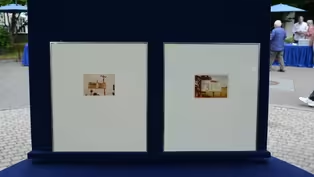
Appraisal: William Christenberry Photos, ca. 1975
Video has Closed Captions
Clip: S30 Ep24 | 3m 41s | Appraisal: William Christenberry Photos, ca. 1975 (3m 41s)

Appraisal: 1962 Rose Cabat "Feelie" Vase
Video has Closed Captions
Clip: S30 Ep24 | 1m 32s | Appraisal: 1962 Rose Cabat "Feelie" Vase, in Thrifty Deals. (1m 32s)

Appraisal: 2004 Green Bay Packers Prototype Gold Helmet
Video has Closed Captions
Clip: S30 Ep24 | 2m 11s | Appraisal: 2004 Green Bay Packers Prototype Gold Helmet from Thrifty Deals (2m 11s)

Appraisal: 1671 Schagen Map & Ortelius Map, ca. 1590
Video has Closed Captions
Clip: S30 Ep24 | 3m 50s | Appraisal: 1671 Schagen Map & Ortelius Map, ca. 1590 from Thrifty Deals. (3m 50s)

Appraisal: Japanese Kannon Figure, ca. 1200
Video has Closed Captions
Clip: S30 Ep24 | 3m 18s | Appraisal: Japanese Kannon Figure, ca. 1200, in Thrifty Deals. (3m 18s)

Appraisal: René Lalique Glass & Silk Necklace, ca. 1920
Video has Closed Captions
Clip: S30 Ep24 | 3m 33s | Appraisal: René Lalique Glass & Silk Necklace, ca. 1920, in Thrifty Deals. (3m 33s)

Appraisal: White Jade Bowl, ca. 1895
Video has Closed Captions
Clip: S30 Ep24 | 1m 24s | Appraisal: White Jade Bowl, ca. 1895, from Thrifty Deals. (1m 24s)

Appraisal: Chuah Thean Teng Batik Textile, ca. 1965
Video has Closed Captions
Clip: S30 Ep24 | 3m 10s | Appraisal: Chuah Thean Teng Batik Textile, ca. 1965, from Thrifty Deals. (3m 10s)

Appraisal: Orrefors "Ariel" Vase, ca. 1945
Video has Closed Captions
Clip: S30 Ep24 | 3m 30s | Appraisal: Orrefors "Ariel" Vase, ca. 1945, from Thrifty Deals. (3m 30s)

Appraisal: George Reynolds Pocket Watch, ca. 1865
Video has Closed Captions
Clip: S30 Ep24 | 2m 57s | Appraisal: George Reynolds Pocket Watch, ca. 1865 from Thrifty Deals. (2m 57s)
Providing Support for PBS.org
Learn Moreabout PBS online sponsorship New Episode

- Home and How To

Hit the road in a classic car for a tour through Great Britain with two antiques experts.
 New Season
 New Episode
 New Episode







Support for PBS provided by:
Funding for ANTIQUES ROADSHOW is provided by American Cruise Lines and Ancestry. Additional funding is provided by public television viewers.