
Washington Week with The Atlantic full episode, 10/9/26
10/9/2026 | 26m 46sVideo has Closed Captions
Full Washington Week with the Atlantic broadcast from October 9, 2026.
Full Washington Week with the Atlantic broadcast from October 9, 2026.
Problems playing video? | Closed Captioning Feedback
Problems playing video? | Closed Captioning Feedback
Major funding for “Washington Week with The Atlantic” is provided by Consumer Cellular, Otsuka, Kaiser Permanente, the Yuen Foundation, and the Corporation for Public Broadcasting.
Washington Week with The Atlantic full episode, 10/9/26
10/9/2026 | 26m 46sVideo has Closed Captions
Full Washington Week with the Atlantic broadcast from October 9, 2026.
Problems playing video? | Closed Captioning Feedback
Where to Watch Washington Week with The Atlantic
Washington Week with The Atlantic is available to stream on pbs.org and the PBS app.
Buy Now
10 big stories Washington Week covered
Washington Week came on the air February 23, 1967. In the 50 years that followed, we covered a lot of history-making events. Read up on 10 of the biggest stories Washington Week covered in its first 50 years.Providing Support for PBS.org
Learn Moreabout PBS online sponsorshipIn 1932, FDR defeated Herbert Hoover for the presidency.
Amelia Heheart made her historic non-stop flight across the Atlantic and the Lindberg baby was kidnapped.
1932 also saw the rise of George McIll, [music] a Democrat sent to the United States Senate by Kansas.
He is notable because he was also the last Democrat Kansas [music] sent to the US Senate.
Somehow though, Kansas, ruby red Kansas, stoplight red Kansas, blood red Kansas might just decide to send a Democrat to the Senate this year.
How is this even happening?
[music] Tonight, we'll take a close look at the everexpanding battleground map [music] and examine what President Trump is doing to prevent a blue wave.
Next, this is [music] Washington Week with The Atlantic.
Corporate funding provided by in 1995, two friends set out to make wireless coverage accessible to all with no long-term contracts, nationwide coverage, and 100% US-based customer support.
Consumer Cellular, freedom calls.
Additional [music] funding has been provided by friends of Washington Week with the Atlantic, including William [music] C. Paley Foundation, George D. Hanby III in memory of Mary Jane Bunny [music] Glick and of his brother Jay Hanby, the Euan Foundation, Sandra and Carl Delay [music] Magnus, Rose Hershel and Andy Shreves, Robert and Susan [music] Rosenbomb, Jay and Sharon Rockefeller, Charles [music] Hamo through the Charles Hamo Fund, Steve and Marilyn Kerman, Leonard and Norma Chlorine, Don and Janine Blum, and the [music] following individuals and by contributions to your PBS [music] station from viewers like you.
Thank you from the David M. Rubenstein studio at Weta in Washington DC, editor-inchief of The Atlantic, and moderator Jeffrey Goldberg.
Good evening and welcome to Washington Week.
Right now, election forecaster Nate Silver is giving the Democrats a 93% chance of winning the House and a 74% chance of winning the Senate.
It is not just Kansas that is in play.
Alaska, Iowa, Texas, and possibly other red state seats are up for grabs.
Assuming that the polls are actually correct, which is a dangerous assumption these days, but one we will make with hesitation, Donald Trump's last two years in office could be very difficult.
Tonight, I'll discuss the Democrat's chances and the president's limited understanding of his own unpopularity with my guests, Carrie Dan, the managing editor of the Cook Political Report with Amy Walter.
Adam Harris, co-host Radio Atlantic, the flagship Atlantic magazine podcast.
Jonathan Carl is the chief Washington correspondent for ABC News.
And Annie Linsky is a White House reporter for the Wall Street Journal.
Thank you all for being here.
John, you're just back from Kansas.
Indeed.
Tell us about Kansas.
What do you find?
Well, well, look, this is a real race.
Uh I was there.
Uh I mean, look, 94 years since they elected a Democrat to the to the Senate.
Uh but there is no there's a reason that this race is now considered a tossup.
There's a reason uh that it is now quite possible that the Democrats have a better chance of winning in Kansas than they do in Maine.
Uh they've got I I spent time with Pastor Adam Hamilton who was the Democratic candidate.
If you'd gone into a lab to try to create the perfect candidate for the Democrats to run in Kansas, you might come out with somebody that looks like Adam Hamilton.
Uh he is somebody with no political uh you know background.
He's most of his life he was a registered Republican.
Uh he is a pastor who is the pastor at the largest church in the state of Kansas.
And he is a a deeply moderate guy.
He will tell you that the middle point of the lower 48 is there in Kansas.
and he calls himself I'm a liberal and I'm a conservative.
But the guys wait and he does this he does but but he but but he but he is deeply thoughtful.
Um and he does uh you know speak to the issues and he's up against Roger Marshall uh who is the you know the Republican incumbent who you may remember uh earlier about a year and a half ago after the big beautiful bill passed uh he did a town hall meeting where he got heckled and got angry with the crowd um and stormed out saying that they were being rude.
He has basically not done publicly scheduled events since then, except he did one today.
It was the first in a long time.
Did they just realize I mean their internal polling is showing bad things for Senator Marshall?
It it it it undoubtedly is.
I mean, the Republicans are spending money uh in Kansas, by the way.
So now are the Democrats.
Um and there both both sides of that coin are interesting.
Yes.
Republicans don't have to spend money in Kansas and Democrats don't bother spending money, which is what it would be.
Yeah, this was not on anybody's list.
But I but there's a reason that the Cook Political Report moved the Kansas Senate race to a tossup just this week.
Look, I don't know.
Are are Republicans going to lose in Kansas?
I mean, that would be a pretty extraordinary thing, but there's no doubt that this is a real race.
Yeah.
Carrie, tell us the truth.
It's just your chicken entrails and tarot cards, right?
It's like when you move a race to toss up.
Well, we climb a mountain and we get the tablets.
Oh, no.
I I I didn't realize it was so elaborate.
So, tell us about what your Tell us about the polling and the decision to move Kansas into toss up.
Almost every cycle there is a incumbent senator who kind of gets caught napping a little bit and and wakes up to the reality that oh, I actually have a competitive race.
We were starting to hear months ago that there was a little bit of concern that Marshall wasn't taking this threat seriously enough.
and from the from the from the Republican side.
Yeah.
From the Republican side.
Um that it is a state that to your point, John, yes, they haven't elected a a a Democrat to the Senate in almost 100 years, but they do have a sitting Democratic governor.
So, it is a state where a D next to your name is not necessarily a death now, even though it is a very heavily read state.
And in Adam Hamilton, you don't get to be a pastor of a mega church unless you are a very, very good communicator and a very earnest communicator.
And you know, follow the money, right?
Uh there is money being spent here, real American dollars that are being spent to prevent Adam Hamilton from winning.
And by the way, the money that went there came out of North Carolina, which should have been an intensely competitive race for Republicans.
They're basically forfeiting there, which really shows the urgency of trying to bail Roger Marshall out.
Now, there Adam Hamilton thinks that he has a very good line of attack against Marshall as an OBGYn.
Marshall's practice sued um over 700 patients for outstanding debts.
Um 81 of those uh individuals faced arrest.
Um and I think in a era when there's a lot of people who are struggling with health care costs and everyday costs, that kind of story really resonates.
Annie, they're really they're really banging on that one in particular, right?
Oh yeah.
When you watch the ads in that race, you have these very compelling stories where you have real Kansas residents who are saying direct to camera, "This is my story.
I was sick.
I had a bill.
It was $50 and I faced arrest."
And so I I feel like those ads have broken through in a way that um you know that could move the needle, right?
Adam diesel fuel.
I mean, honestly, all of these things are are connected, right?
If you're thinking about affordability, you're thinking about people who are getting sued over their medical bills, right?
The idea of having a better medical system, Medicare system has been in the American um sort of water for the longest time.
And so, um, but if you you think about some of these races that Republicans are functionally looking away from now, right, thinking about North Carolina where, um, Democrats really just feel like they've had it was a godsend, right?
um in and the recruiting of the candidate for for the office because it's somebody who had who had won office before was a strong candidate um and and they're moving that money to places like Kansas because you know you you they're having to play defense where they didn't think they would.
Now, Democrats are also sort of feeling some of that um some of that pinched because the as the sort of blocks are moving around the board because you look at Maine now, um a state where, you know, Susan Collins has been dogged by uh the sort of question about abortion where she says, "Well, you know, I I she she ends up voting for a Supreme Court candidate who uh oh, he told me that he wasn't going to do anything about Roie Wade."
And then, of course, Roie Yeah, but Susan Collins is always going to Penelopey pit stop her way out of like a danger, though.
She always does, right?
She's She's sort of like the Democrat's wife.
Is that an antiquated reference?
[laughter] Yeah, it might work for the audience.
Ma, I think Does it work in Wayne?
All right, maybe it works in Maine.
But but no, I mean, she caught Look, she always gets out of a jam.
She caught a lucky break when Graeme Platner turned out to be Graham Platner.
Um, and she's up against a second tier candidate.
I mean, Maine is Maine is Maine and she won by nine points in a year where Joe Biden won by nine points in Maine, right?
You know, and the other thing, she's just did her second debate in a week.
Uh, and she's doing four debates and she's not, you know, running and hiding.
I mean, this is a contrast with some of these other candidates.
I mean, Roger Marshall, absolutely.
I mean, very few public events, very few interviews that aren't with extremely friendly outlets.
Not many of those uh either.
And, you know, Susan Collins is out there.
And I I I think you see a different result.
My favorite Oh, I was just going to say my favorite um uh result in there was a Washington Post poll of the main race.
That poll, by the way, did show um Collins behind, but one of the questions they asked is of Maine likely voters, have you voted for Susan Collins before?
[clears throat] And 70% of Maine voters [laughter] have voted for her before.
So, not only does she have universal name ID in the state and some fairly, you know, high goodwill from her constituent work, but people have voted for her and now Troy Jackson has to ask them, "Hey, I know you voted for her before, but you got to vote for me now."
That that is a she's still running in a state that Kla Harris won convincing.
I'm not saying easy.
I'm just saying she always she always car Let me stay with you for a second.
Tell us about the polls in other deep red states.
Alaska is an obvious one.
Uh Nebraska, right?
And if we had had this conversation um a year and a half ago, I would have thought I had been dropped from Mars that were talking about any of these races or that we're even talking really plausibly about Democrats perhaps losing Maine and having a path to a Senate majority.
But the way that it stands now, Democrats have expanded the map so that they're looking at very plausible competitive races in Alaska, as you mentioned, in Ohio, in Texas, um in Kansas, uh and um as you mentioned, in Nebraska.
Now, this is a really unique situation um because the candidate who's running is running as an independent.
Um, it's clear from all of the Republican advertising that they're trying to drop on the stage to they want to remind everybody Dan Osborne is running as an independent, but he's going to caucus with Democrats.
Now, this is not the first time that Dan Osborne has run in Nebraska in the last even two years.
He ran two years ago, came up as an independent, came up six points short, which was sort of a a shock at the time in that cycle.
Deb Fischer, by the way, was probably the equivalent of a candidate who got caught napping and didn't take that threat seriously.
The real question is, does that trick play work two times in a row?
Yeah.
Um, but it's interesting.
I mean, the Democratic brand is so toxic in some of these, uh, you know, western states that you have not just in Nebraska, but also in Idaho, in South Dakota, and Montana, uh, independent candidates running.
And in the cases [clears throat] of of, uh, Nebraska, Montana, and Idaho, they've actually the Democrats actually withdrew their candidate.
So, the only candidate, the only major candidate on the ballot against the Republican is an independent.
And that's done because they know.
Now, I don't know if any of those independents, I mean, I mean, uh, you know, Nebraska is the best chance.
They're all long shots.
But the only way you have even a long shot is if you don't have a D next to your name.
Yeah.
Um, by law, we're mandated to talk about Michigan, [laughter] even though it's actually not the most interesting [clears throat] one of these, but it's pretty interesting.
It's pretty interesting.
No, just not as interesting as Alaska, which shouldn't be discussed at all.
That debate was certainly compelling.
Yeah.
And if you look at the landscape in Michigan, I mean, Michigan is a state that has um been hit hardest by the Trump tariffs at I think the tariff burden in Michigan is over $5,000 a household.
So, this is a place that was, you know, a swing state that Trump won just, you know, two years ago.
But this is where Trump's policies have, you know, bled out of Washington and are really hitting home.
And so if you if you are paying, if you can imagine a 5 thou, and this is on average $5,000 burden per household in Michigan, suddenly it becomes quite, you know, it it opens the door for a Democrat, even a Democrat whose um, you know, views are are outside of the mainstream.
I mean, in these other cases, we're talking a much more natural politician, I I think.
No, it's he's he's pulling it off certainly.
I mean, also I mean he's been on Fox a bunch of times, which is a great move for very very for highly articulate Democratic candidates and Democratic figures.
Pet Buddhajed is obviously the trailblazer on that, but it's not a bad move.
But especially if you're being portrayed uh by the right as this kind of jihadist uh this this this extremist, this dangerous, you come on, you're like you're getting along and you're joking along with Jesse Waters and you know, and everything is is is fine.
But I thought the key moment in Michigan was seeing uh Mike Rogers doing an ad drinking a Lebats, which as you know is a great Canadian beer, and saying, you know, we can't have a trade war with with Canada.
Canada's our friends, right?
It has to break on it has to break on and the war.
He's broken on the war as well.
He's broke on the war and he's a hawk usually.
I mean, it's not that that's a little bit surprising.
Uh just one more state, Carrie.
Ohio.
Um Houston not looking so great for him.
Um, I mean, this is a this is a state that's so interesting to me because I think um voters may would be forgiven for being a little bit confused about who the incumbent is because shared Brown served for so long and John Houston has been pretty low profile uh and and would very much like voters to think that Sherid Brown is the incumbent.
There's a lot of ads that he and his allies are airing reminding folks, well Sherid Brown has represented the state for 50 years, like it's sort of time for someone new.
Well, you're the actual the incumbent.
One of the big animating issues there aside from the fact that shared brown is also has sort of universal name ID uh in the state is has been data centers.
Data centers have been really resonant in a lot of different races but this is a place where shared brown I think recognized early that the politics of this were going to be on the more populous side.
Let's talk about the undergirling issues.
Every state has its own preoccupations, but um diesel fuel, gasoline prices, uh data centers and corruption and corrupt.
No, go ahead.
Well, yeah, time for both.
I think you [laughter] can go ahead.
I think Yeah, we could both do corruption.
I think it's it's just indicative of the ways that all of the things that we are talking about now.
In the same way that, you know, any midterm election is going to be a referendum on the president's policies, what we're seeing right now is a referendum on the president's policies over the last two years, right?
You you have the war in Iran that he can't tether to Joe Biden and say, "Oh, your prices are up because of Joe Biden because that's that's fuel as a result of something that nobody most Americans wouldn't have known about last year, which is the straight of four moves."
Um, right?
If you if you ran a poll from January of 2025 or 2020, even this year, and said, you know, have you ever heard of the straight of four moves?
Most people would say no.
But now they can tether um the president's policy specifically from the war on down.
It's why it's why you see folks like you said sort of trying to walk away or Mike Rogers walking away from uh the president trying to to sever to sever that tie and the and the administration sort of letting them do that.
Right.
So if alternate history here if he hadn't gone to war with Iran and then I don't want to say lose because it's not a loss yet but it's not a win.
uh and the Iranians hadn't discovered for themselves that oh we can stop oil from moving to the straight of Hormos.
They knew that a long time ago actually um would we even be having this conversation about the Republican uh Republicans on the defensive?
I I think that's a such a good question and it's a topic that comes up um repeatedly when I talk to my Republican sources who some of whom are very close to Trump, very close to the administration and they have been saying um candidly since really since March, this war is going to kill us.
This war is killing us.
and they they point they they say that they could have overcome the tariffs um even some of the immigration roundups which have become very unpopular which we haven't talked about but you know surprisingly immigration has been an area where um Trump has has lost well he's certainly losing what he whatever he gained in Hispanic votes but but they really feel that the war and the increase in prices and the increase specifically to your point in diesel prices because that is what drives up the the food co food costs and is hitting so hard in these farm states.
Yeah, the farm states.
It's it's I mean heard it over and over again this week in Kansas.
You see it in Iowa.
He took two major moves this week.
One, you know, just today to lift sanctions on Russia to allow Russian diesel fuel to come and sort of come to the aid and also um his EO on the um the red dye the red dye diesel which which the farmers will tell you does nothing, right?
John, I wanted to ask you about that.
I mean, he's now importing diesel, small amount of diesel from Russia, which I should point out imports soldiers from North Korea to fight the US backed Ukrainian government, it's quite it's quite a move.
Um, is it going to make any difference in diesel prices?
And even if you could move diesel prices in two or 3 weeks, is it too late?
Is this thing fixed?
Look, I I I I think that the Russia deal actually is going to make a big difference.
Not with diesel prices, but it's going to help Russia.
uh you know it's a uh it's a lifeline to the Russian economy.
It'll have a much greater impact there which is why you saw the reaction you saw from Zinski today.
I mean about as you know strong a reaction back on this.
This is this is not something that's going to move the needle in the United States on diesel prices but but it but it does move the needle perhaps uh in Ukraine.
Carrie, I have a question about and this is sort of like political like fantasy football kind of thing, but but um and it's nobody's I'm not saying it's any of our fantasies.
It's just interesting.
This the the the Senate could be 40 5149, right?
We come out of this at 5149.
Does Federman of Pennsylvania jumped the Republican party, which would of course make the Senate 5150 because Vance would be the tiebreaking vote.
Is that a possibility that Federman would actually jump if the Republicans promised him enough?
I mean, I will say I have John Federman has been asked this question probably five dozen times, right?
It is not a recent development, right?
Um whether it was in the context of it being a of the control of the Senate or just generally because of some of the votes that he's taken and because of the way that he spec specifically that he's talked about the Israel issue, he has said absolutely not every single time that I have seen him been asked.
Um I don't want to speculate what happens when all of that pressure is on him.
Um because there will be pressure and its endorsement and and an an immense amount of pressure on him.
I we can just point to the the record in the past of he's saying I mean you can see from his perspective um because of these votes that he's taken.
He has has very little and if you could probably say no path to uh get through a Democratic primary if run away run again.
Um you do you have seen polling that shows he is more popular in his home state among Republicans than Democrats.
Um and also if you just watch him on the Hill you know you see him hanging out with with Republicans whether it's Katie Brit or Dave McCormack.
I mean he seems to have more of a natural affinity there.
So you can understand why the you know the ingredients are certainly and there's a reason he's been asked the question five dozen times.
I mean he is friendly with Republicans.
Sure.
He spoke at the Republican convention, midterm convention in Dallas.
Uh I mean, this is You're like Sherlock Holmes.
[laughter] I think I think there's a possibility he's going to switch parties.
Noticing a pattern.
Um I mean, I we we all saw this happen.
Some of us were old enough to, you know, in in in 2001 when Jim Jeffs, who was the Republican senator from the state of Vermont, it was a 5050 Senate.
You broke that story.
Yeah.
Yeah.
And I remember that since you reminded me of [laughter] it.
Yeah.
Yeah.
Yeah.
I remember that.
Um but but but the pressure and and and the reward can be quite high, right?
Um I want to talk about the president in our remaining few minutes.
I I just want to note um that the president posted on Truth Social the following message uh on Thursday.
Uh the White House considers anyone that uses the term artificial intelligence as opposed to the highly accepted new and more accurate term super intelligence the enemy.
So he's clearly focused on the midterm elections and the consequence.
I mean he's really he's really getting right at the heart of the the matter.
I mean this is I mean you two are in the White House uh all the time.
uh what are they saying about the president's uh attention to to this and um does he even care?
Yeah, I mean look, yes, he does care.
I mean, he he does care and I think um there is a little bit more um you know, there's a little bit more kind of deeper under the surface here.
I mean, you know, one thing I would say, I mean, first of all, he's going to spend a lot of the next month on the road and he is traveling to these the states.
He's going to Alaska.
He's going to Alaska and there's a reason for that.
He knows that he is the best person at turning out this MAGA coalition.
And the Republicans are right about that.
And if you talk to people at the White House, they will say to you, look, we have we have heard these naysayers before.
We have heard Washington write us off in 2016.
And I, you know, I can go through, we are all familiar with the elections.
Um, they say that we are on we're playing on a a red playing field that these are Republican voters.
These these races are going to narrow.
the polling will narrow.
You talk to Democrats and they will tell you the same thing that these races are going to come closer together towards the end, right?
And they have the money.
They have a lot more money.
If he loses Congress, Adam, this is a large essay question that I'd like you to answer in 60 seconds, but what does it mean for him and his party?
I mean, as a lame duck, right, I think it means investigations.
I think what we saw um right before the house broke for recess where you had Pete Pete Hexith brought up um for you know impeachment right I think what we will see is several investigations potential impeachment inquiries into both cabinet members and the president um and and effectively it's it's jamming up any semblance of an agenda or success in an agenda that he would see for this u John last word to you on this because you've obviously covered the man himself How would he react to the loss of Congress?
I mean, I think that's the big question is how does Trump what are the last two years of a Trump presidency look like with his back against his wall looking at a Democratic Congress that is gunning for him?
Um, and we we've seen what he's like with the back against the wall and I think most dramatically we saw that after he lost the 2020 election.
Uh, and he drove that fight further than anybody could have imagined he would drive it to January 6th.
And I I I don't know.
There's going to be two paths he can take.
He can take that path.
Mhm.
God knows what that means.
You mean just sort of self-radicalizing in a kind of way and just just dig in and war with Remember the Congress and the president have to actually work together to like make the government function.
They have to pass books and all this.
Yes.
Yes.
So I mean, but the last time he this happened, we saw the longest shutdown in American history, right?
So does he does he go and in that direction or is it the dealmaker?
Uh does he feel like, you know, just like I can get a deal with the Iranians, which he hasn't quite pulled off yet.
Uh but but but he loves to, you know, to to deal with the the people you can't deal with.
Does he make it with Democrats?
Well, we'll find out soon enough.
I mean, uh we are going to have to leave it there, though.
Um, I want to thank our guests for joining me and thank you at home for watching us.
Be sure to join us next week for a special hourlong Washington Week on the fight to control Congress.
We'll be broadcasting from the battleground state of Texas, the home of one of the country's most expensive and closely watched Senate races.
I'm Jeffrey Goldberg.
Good night from Washington.
Corporate funding for Washington Week with The Atlantic is [music] provided by Consumer Cellular.
Additional funding has been [music] provided by friends of Washington Week with the Atlantic, including William C. Paley [music] Foundation, George D. Hanby III in memory of Mary Jane [music] Bunny Glick and of his brother Jay Hanby, the Euan Foundation, Sandra [music] and Carl Delay Magnus, Rose Hershel and Andy Shreves, Robert and Susan Rosenbomb, Jay and Sharon [music] Rockefeller, Charles Hamoy through the Charles Hamo Fund, Steve and Marilyn Kerman, Leonard and [music] Norma Chlorifine, Don and Janine Blom, and the following individuals [music] and by contributions to your [music] PBS station from viewers like you.
Thank you.
You're watching [music] PBS.
Yes.
 New
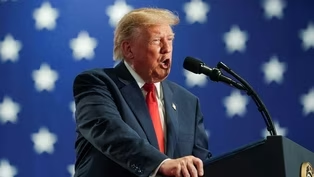
NewTrump’s policies put Republicans on the defensive
Video has Closed Captions
Trump’s policies put Republicans on the defensive (10m 7s)
 New
NewWhy the map of battleground states is shifting
Video has Closed Captions
Why the map of battleground states is shifting in surprising ways (12m 55s)
Providing Support for PBS.org
Learn Moreabout PBS online sponsorship New Episode
- News and Public Affairs

Top journalists deliver compelling original analysis of the hour's headlines.
 New Episode
- News and Public Affairs

FRONTLINE is investigative journalism that questions, explains and changes our world.
 New Episode
 New Episode
 New Episode
 New Episode
 New Episode
 New Episode
 New Episode
 New Episode
 New Episode
Support for PBS provided by:
Major funding for “Washington Week with The Atlantic” is provided by Consumer Cellular, Otsuka, Kaiser Permanente, the Yuen Foundation, and the Corporation for Public Broadcasting.